

In a rush? Click here to read a short summary of this article?
Introduction:
The Ocean Bound Plastic Certification released a report which estimating that ocean-bound plastic (OBP) generates up to 80% of plastic marine litter and outlining four different categories of OBP. This edition of the Brief examines how ocean-bound plastic is used in packaging, the arguments surrounding its use, and future plans and strategies to tackle it.
Key takeaways
- OBP is being utilised in packaging through social enterprise collection schemes, as a feedstock after being chemically recycled, in food packaging trays and in recycled plastic granules.
- The main arguments around the use of OBP include creating demand for reclaiming plastic waste; its potential to mitigate marine plastic issues through its use in industrial materials and recycled plastics; and safety concerns around its use in food packaging regarding potential toxics and additives when sourcing plastic.
- Future plans to tackle OBP involve “urgent and coordinated action” across countries alongside international support to accelerate improvements in waste management systems and practices in least developed countries, and further commitment from industry and governments, as stated by the WWF’s position paper.
Conclusion:
Whilst there is potential for OBP to be incorporated into flexible packaging such as SABIC and Scientex’s collaboration, cosmetics such as Ocean Legacy’s plastic pellet in LUSH pots, or food such as Lidl and Tesco’s fish packaging trays, there are concerns around its safety for use in food packaging. It remains to be seen whether the use of OBP will remain experimental and in combination with other packaging materials, or if it will be implemented on a larger scale in future.
In this edition of The Brief, we will be looking at how ocean-bound plastic is being used in packaging, the arguments surrounding its use (particularly in food packaging), and future plans and strategies to tackle it.
Ocean-bound plastic (OBP) is plastic waste defined as “at risk of ending up in the ocean” and estimated to generate up to 80% of plastic marine litter, according to the Ocean Bound Plastic Certification. “Abandoned plastic waste” includes microplastics and macro-plastics (marine litter larger than approximately 0.5 centimetres), located within 50 kilometres from shores where waste management is inexistent or inefficient. When already in a landfill or managed dump site, the plastic waste is not considered OBP; however, when abandoned in an uncontrolled or informal dump site, this waste is considered OBP.
The Ocean Bound Plastic certification has outlined four different categories of OBP: potential OBP, inadequately collected plastic waste located within 50km of the coastline; waterways OBP, inadequately collected plastic waste located 200km from rivers and in rivers; shoreline OBP, inadequately collected plastic waste located 200m from shores; and fishing material, such as used fishing gears and plastic bycatch.
In November 2022, Greiner Packaging extended its cooperation with social enterprise Plastic Bank in an effort to collect plastic to be returned to the global supply chain. Plastic Bank’s Ocean Stewards collect plastic in their local communities in the Philippines, Indonesia, Brazil, and Egypt to prevent it from entering the ocean, in exchange for ‘life-improving benefits’ including secure income, health, work, life insurance and digital connectivity. The collected material is apparently then processed into the company’s Social Plastic feedstock for reuse in products and packaging.
December saw SABIC and Scientex collaborate to produce flexible packaging for a Malaysian noodles brand by chemically recycling OBP, to be used as a feedstock to produce polypropylene. The OBP will reportedly be converted into pyrolysis oil, which will become an alternative feedstock for SABIC to produce polypropylene, said to contain 30% of OBP. The feedstock will then be processed to create a BOPP film for Scientex to manufacture and print the noodle packs.
It also saw Ocean Legacy claim to have produced the first commercially available plastic pellet in North America, made from 100% post-consumer processed recycled marine plastics. The non profit’s ‘Legacy Plastic’ is allegedly made from plastic waste such as fishing ropes, buoys, floats, and oyster trays collected during clean-ups, which are then reprocessed and reused to manufacture new products, for example in test batches of LUSH’s black product pots and clear bottles.
Moving on to this year, in January Tesco announced its partnership with Keep Sea Blue, incorporating recycled plastic into its fresh fish packaging in an effort to keep 500 tonnes of discarded plastic out of the ocean. The supermarket’s salmon, haddock, cod, and sea bass lines will be sold in trays containing at least 30% recycled coastal plastic collected from beaches, coastlines, and coastal communities within 10km of the Mediterranean Sea, hoping to facilitate the reduction of virgin plastics in the packaging and at-risk environments near the ocean. Keep Sea Blue said that it planned to ensure full traceability by monitoring and certifying the circularity of the plastics via its Blockchain Platform, powered by Oracle Blockchain technology.
Two months later, Sukano partnered with tide ocean SA on rPET made from ocean-bound plastics. Sukano is the global distributor and partner for tide ocean SA additive and colour masterbatches for its #tide ocean-bound rPET material – which is upcycled via a mechanical process that reportedly regenerates the molecular chains of damaged ocean-bound plastics. #tide utilises blockchain technology to track its material flows from collecting plastic waste to delivering recycled plastic granules to its customers, with the data said to include photographs, volumes, and information about individual processing steps saved on a public blockchain to ensure security and transparency.
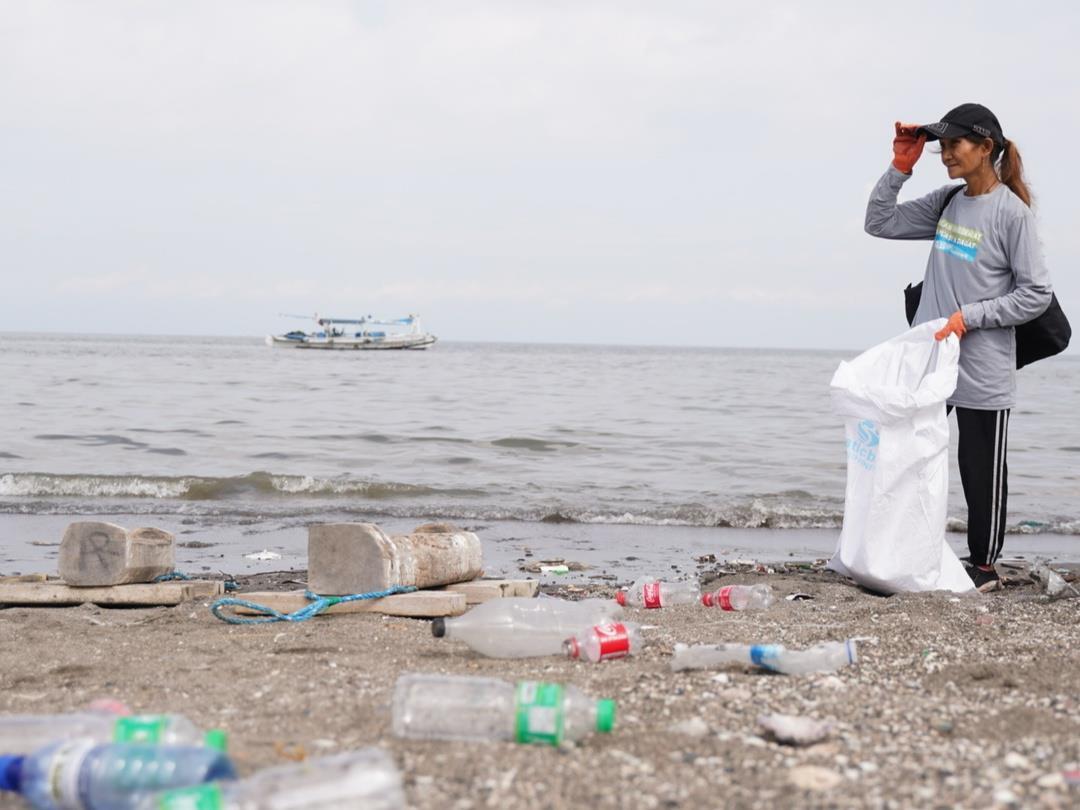
One of Plastic Bank’s Ocean Stewards collecting plastic on the beach.
There are a number of arguments surrounding the use of ocean-bound plastic in packaging, from creating a demand for reclaiming plastic waste and commitment to preserving the planet to concerns over safety when used in food packaging.
To start with, Graham Packaging has incorporated ocean-bound plastic into its product packaging, using PCR (post-consumer recycled) content which includes OBP. It argues that using this resource contributes to a healthier, cleaner planet and shows customers your commitment to preserving the planet. In its own portfolio, it states: “we offer food-grade and non-food-grade packaging solutions that incorporate ocean-bound PCR,” as well as “exploring blending options that combine regular PCR with ocean-bound PCR. We can run ocean-bound plastic PCR in both single-layer and multilayer bottles today.”
UPM Raflatac has also added ocean-bound plastic into its products with the Ocean Action label, made from OBP through mass balance approach in white and clear ISCC PLUS certified C-PCR film. The company claims it is the first “to offer a product that uses ocean bound plastic as a label material”, aiming to create a demand for reclaiming plastic waste before it pollutes the oceans.
The labeller adds that due to chemical recycling it has identical properties to standard PP film, making it “a drop-in solution requiring no additional process adjustments” and allowing brands to have a higher percentage of recycled material in their packaging while avoiding the use of virgin fossil raw materials .
Writing as a guest for The Economist Impact’s World Ocean Initiative, Seah Kian Hoe, manager director and founder of Heng Hiap Industries, said in 2020:
“Ensuring ocean health is no longer a matter of choice, but an urgent priority. OBP collection is one approach to mitigating marine plastic issues. By converting plastics into industrial materials and integrating the use of recycled plastics into the mainstream, potentially harmful plastic debris can transform into a second-life solution.”
He went on to say that business models that consider the entire lifecycle of a product - from production to use to potential reuse – “can help shape (…) circular supply chains and stop OBP before it turns into harmful ocean pollution”, and collaborating with supply-chain stakeholders while working within existing environmental, social and governance (ESG) frameworks must be central to these efforts.
Highlighting the importance of building trust with consumers, he suggested “embedding transparency and traceability within circular business models” can help verify the source of recycled plastics in products and empower consumers to make more sustainable plastic-based purchases, adding that these initiatives can shift perspectives around plastic and help grow demand for responsibly recycled materials.
On the other hand, there are safety concerns around the use of ocean-bound plastic in food packaging. In 2020, Lidl announced that from March it would start using food packaging made from OBP collected from South-East Asia, made from 80% recycled content and a minimum of 30% of the weight of the tray made of OBP, with the packaging rolled out across 13 fresh fish products.
As part of an opinion piece published on Environmental Health News’ website, founder and scientist Pete Myers gave his views on Lidl’s announcement, saying “it may be well-intentioned, but for someone who understands plastic toxicity, it’s a horrifying idea”, highlighting potential toxics; additives; unintended ingredients; and absorption of toxic substances from the environment as key issues when sourcing plastic.
On the subject of feedstocks, he stated that “to make plastic out of a feedstock that is absolutely 100% pure would be wildly expensive”, referring to the existence of impurities which react during the making of plastic to form NIAS [non-intentionally added substances] and underlining that other chemical processes produce NIAS even with pure feedstock.
Myers voiced his concerns that recycling possibly safe and toxic plastics together winds up with “unquestionably toxic materials”, emphasising that “we don’t want that in our food supply because stuff in packaging migrates into the food we eat”. Ultimately, he declared that:
“Plastic recycling solutions that don’t address the toxicity of the recycled product are part of future problems.”
In terms of OBP’s safety for use as food contact material, in March 2022 the Food Standards Agency issued a call for evidence on the safety of plastics recovered from the open environment. The agency aimed to gather further information on how business operators “propose to, or currently, carry out their own risk assessment to determine the safe use of recycled plastic that has been sourced from the open environment (ocean, ‘ocean-bound’ or land), in FCM [food contact material] products”, taking into account sourcing from countries with different waste management infrastructures to the UK and EU, and where information on the previous use or misuse of the plastics is less certain.
In a news article, the FSA mentioned an initial evaluation on ocean-bound plastic by the Joint Expert Group on Food Contact Materials (FCMJEG) which provides independent advice to the FSA, stating the evaluation’s findings that on the available evidence “it has not been possible to guarantee that the use of this material in food contact products is without risk – either in direct contact with food, or as a middle layer.”
A summary of the replies to the call was published in February this year, showing varied responses. Faerch stated they currently do not use recycled OBP in their products, as they had investigated this and “do not have the necessary assurances that they will be able to carry out an accurate risk assessment to inform compliance.”
However, Sharpak apparently provided information on their manufacturing sites, analytical results and traceability of their plastic material, with the respondent confirming that “due to their due diligence practices and working to EU and EFSA standards they are able to provide full certification regarding the packaging adhering to all food contact safety standards.”
So, where does this leave us? What does the future look like regarding ocean-bound plastic?
In December 2022, WWF published a position paper setting out a framework for the scaling of sustainable reuse systems for plastic packaging. The paper states that:
“The solutions needed to reduce leakage of plastic into the ocean by at least 80% by 2040 are already available, but current commitments by industry and governments would only amount to a 7% reduction in plastic flow into the ocean by 2040 if implemented.”
It also adds that global progress is hindered by barriers such as inadequate government policy on local, national and international levels; static business models; and a lack of funding mechanisms. The prevention of plastic waste is “the highest priority waste management strategy, followed by reduction”, and reuse systems should complement other reduction strategies, for example cutting down on unnecessary packaging and entirely phasing out single-use plastics where possible.
Looking further ahead, in February we discussed the findings of the OECD’s Global Plastic Outlook report and ways to avert the predicted tripling of plastic waste by 2060 with Shardul Agrawala, Head of the Environment and Economic Integration Division of the OECD Environment Directorate. He declared that in order to achieve drastic reductions in plastics use, waste generation and the related environmental impacts, urgent and coordinated action across countries is essential, alongside international support to accelerate improvements in waste management systems and practices in least developed countries.
He elaborated: “Our modelling projections find that the global implementation of ambitious circular policies to curb plastic leakage to the environment can reduce plastics use and waste by a third below business-as-usual projections and reduce mismanaged plastic waste to almost zero by 2060, at an annual cost of less than 1% of global GDP. However, the bulk of the costs will be borne by non-OECD countries, as substantial investments must be made to ensure that everyone has access to adequate waste collection and disposal services.”
Whilst there is potential for ocean-bound plastic to be incorporated into packaging - whether in flexible packaging such as SABIC and Scientex’s collaboration; cosmetics such as Ocean Legacy’s plastic pellet in LUSH pots; or food, such as Lidl and Tesco’s use of OBP in trays for fish packaging – and a need to prevent and reduce plastic waste from entering the oceans as emphasised by WWF, there are also concerns, particularly around its safety for use in food packaging.
Ultimately, it remains to be seen whether the use of OBP in packaging is something which will remain largely experimental and used in small quantities in combination with other packaging materials, or if we could see its implementation on a larger scale in the future, not only in the next few years but beyond.
Sponsored stories

How ATS-Tanner’s banding solutions align with the new PPWR
ATS-Tanner’s banding solutions aim to reduce packaging waste, provide a practical alternative to plastic and improve recyclability. In

How Rollon’s linear systems provide reliability for tertiary packaging
Rollon believes tertiary packaging machinery must perform without fail, showcased by its recent partnership with AMP Automation to develop palletizing

Discover what’s new at London Packaging Week
Packaging has never carried greater commercial responsibility. It influences how consumers perceive brands, how products perform in increasingly competitive markets

Paperworld Middle East partners with FSC to champion responsible sourcing across the region’s paper and stationery industry
Paperworld Middle East, the region’s leading trade show for paper and stationery products, taking place from 13–15 October

Made for Life: How Sappi reveals what trees make possible
What connects an experienced papermaker, the creators of cactus-based leather, the people conserving forests for future generations, and a

The advantages of all-electric adhesive dispensing in modern packaging
Packaging manufacturers are under constant pressure to increase output, reduce operating costs, improve sustainability, and maintain consistent product quality. One

YUTO won 12 international packaging design awards across three global competitions
Driven by the global sustainability trend, the EU PPWR mandates packaging reduction, recyclable design, and restrictions on single-use packaging.

How rPS Food aims to bring circularity to polystyrene packaging
In this edition of the Spotlight, Coexpan (part of Grupo Lantero) details how its rPS Food enables up to 100%
Read next

Your chance to decide the winner of our 2026 Readers’ Award
The nomination period for Packaging Europe’s 2026 Readers’ Award has ended, the finalists have been selected, and now it’

Nemera launches bi-dose nasal spray solution
Drug delivery device company Nemera has announced its DuoSpray bi-dose nasal spray platform, a ‘non-invasive, needle free’ administration

Coveris develops mono-material sleeve with 30% less material for Dr Beckmann
Coveris has unveiled its mono-material sleeve solution developed for Dr Beckmann, said to use around 30% less material than