

In a rush? Click here to read a short summary of this report
Introduction
With regulation tightening and pressure to decarbonize mounting, innovation is shifting from niche breakthroughs to scalable, systemic change.
Key Takeaways
- Fibre-based packaging leads innovation: 62.5% of our judges highlighted significant advances in renewable, paper-based alternatives to plastic—balancing functionality with recyclability.
- Reuse and refill gain ground—but lag in scale: While half of judges noted progress in reuse systems, many stressed that innovation must now focus on infrastructure and uptake rather than novel concepts.
- Circular plastics still face systemic barriers: Progress is emerging in mono-material designs and recyclability of closures and shrink sleeves, but global alignment on recycling standards remains a key hurdle.
- AI is starting to deliver practical sustainability benefits: From automated waste sorting to predictive supply chain optimization, AI is quietly transforming packaging efficiency and data transparency.
- Regulation is reshaping packaging strategy: The PPWR is pushing brands to adopt recyclable, reusable, and lightweight formats—fuelling innovations like the ECOTWIST aluminium multipack and Kraft Heinz’s sachet alternatives.
- Scalability is now the name of the game: Judges overwhelmingly cited waste sorting infrastructure (87.5%) and slow innovation timelines as the biggest barriers to industry-wide transformation.
Conclusion
This year’s innovations show real momentum, but the sector is now grappling with how to scale and integrate them. The focus is shifting from isolated breakthroughs to enabling systems—recycling infrastructure, regulation, and consumer behaviour—that can support a circular economy at scale.
This is our third annual innovation report, in which we look at the entries to our 2024 Sustainability Awards, combined with our wider observations of market trends, to give a picture of the industry progress over the past year and what we might expect in the year to come.
As ever, this report indicates the wider trends we have observed but gives only a snapshot of the vast amounts of innovation going on in the area of sustainable packaging. We encourage our audience to use this as a starting point to explore the many other exciting projects, whether commercialized or in the development phase, in the areas outlined below.
Key innovation trends identified for 2024
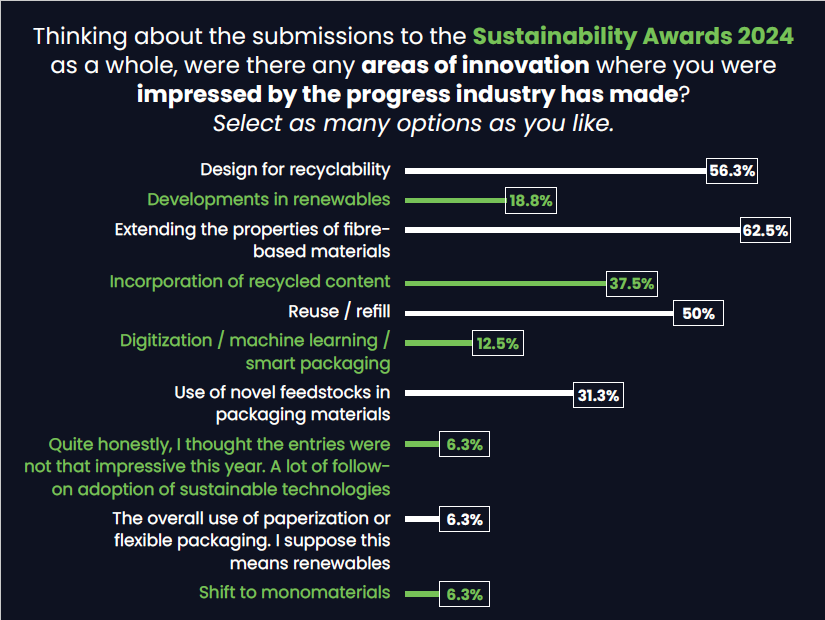
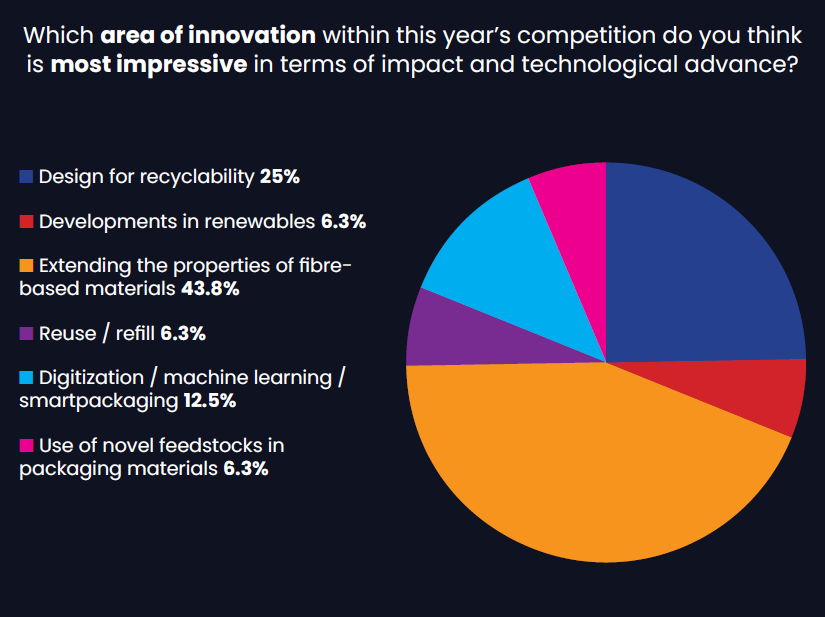
As always, we asked our Sustainability Awards judges in which areas of innovation they had been most impressed by the progress made. Extending the possibilities for fibre-based packaging scored highest, with 62.5% of respondents mentioning this, followed by design for recyclability at 56.3% and reuse/refill at 50%. It was also noted that there had been some progress in incorporation of recycled content (37.5% of respondents) and developments in renewables (18.8%).
It’s worth pointing out separately that, last year, our judges felt that reuse/refill was the area in which innovation is most urgently needed. It’s somewhat positive therefore to note that 50% of respondents have been impressed with innovation in this area over the past year; having said that, as we shall see later on in the report, the majority still feel that innovation is not happening fast enough.
Areas we will focus on this time include renewable alternatives to plastics (particularly paper), innovation to further plastics circularity, AI and decarbonization, among others. We will also discuss how the requirements laid out by the PPWR, adopted last year, have been, and will be, shaping packaging development. (All this with the usual caveat – there is there are inevitably overlaps between the different categories below, which only serves to demonstrate how interlinked all aspects of sustainability within the value chain really are; none of these things exists in isolation from another.)
Renewable alternatives to plastics
Over the past year we have seen a continuation of efforts to develop renewable material solutions – most notably paper-based – to replace plastics where this is feasible. Indeed, last year there were more entries than ever in this category.
While the work in this field does not, of course, mean that we can replace plastics entirely with renewables, it’s clear that there is a demand for alternatives where feasible and there is space for innovation in both areas. As always, though, this must be balanced at all times with the need for resource efficiency and product protection, looking at each individual use case.
Moving on now to look at specific examples of innovation in the field of renewable alternatives, we turn first to Upfield’s plastic-free, oil-resistant, and waterproof wet fibre moulded tub for plant-based spreads, the winner of the Renewable Materials award. This solution uses paper from a PEFC-certified supplier and has received Conventional Plastic Free Certification. Decorated with MCC Verstraete and Pagès Group’s Moulded Fibre Labelling, the pack is mono-material and therefore recyclable. It does not have a plastic liner, which the company says means it can be cleaned, dried, and recycled alongside paper and cardboard household waste.
Another fibre-based solution to fulfil a function previously met by plastics is Lantmännen Unibake Finland’s its food-safe cardboard box with a barrier paper inner, designed in collaboration with UPM Specialty Papers and Adara Pakkaus to replace plastic inner bags for retail and food service while ‘ensuring food safety and quality standards’.
Another company nominated in our Commercialized Renewable Packaging category was Huhtamaki, with its OmniLock Ultra Paper. Designed to replace non-recyclable multi-layer laminates, Omnilock is a recyclable, heat-sealable paper which can “deliver ultra-high barriers which have previously only been achievable through non-recyclable, multilayer, aluminum foil/plastic combinations. This breakthrough means that packaging can now be fully recyclable while maintaining essential protection, such as moisture and oxygen barriers, without compromising the shelf life of products.”
The focus of innovation is not just on improving the functional abilities of papers – we have also seen the development of new kinds of materials to replace plastics where appropriate. Paptic has developed what it says is a recyclable material alternative to pack surface-sensitive items. According to the company, the material, which is made from wood fibre, is “lightweight, durable, and soft, protecting delicate items like electronics, personal care products, furniture, and fashion accessories. It is scalable, FSC certified, and recyclable with cardboard, the most developed recycling stream globally.”
Another example of an innovative renewable material we have seen is the home compostable monomaterial tub from Shellworks, made from Vivomer, a biobased material created from microorganisms and suitable for food and personal care products.
For a company to replace plastic with paper-based packaging for certain products they may also need to adjust or even replace their production machinery - therefore, there has been consistent innovation in this area to accompany the material innovation. Flexform, one of the latest innovations from Westrock, is a series of trayformers specifically designed to provide flexibility and consistent handling of performance-matched corrugated and paperboard materials.
According to the company: “An alternative to traditional plastic packaging, the resulting fibre-based small format trays, tills, punnets and clamshells suit a wide range of product types and perform well through your production line and distribution system.”
Finally, it’s worth mentioning how certain marking technologies can contribute to – or, conversely, hamper – the recyclability of renewable-based packaging. An example of the difference this can make comes from Cajo Technologies, another of our awards finalists, with its laser marking technology for cardboard, Cajo MakeBright.
According to the company, “MakeBright produces precise, permanent markings on cardboard without the need for inks, adhesives, or ribbons, which eases recycling and significantly cuts production operational costs. This system supports high-speed, on-the-fly marking for mass production lines while enabling late-stage customization through flexible Cajo software, minimizing inventory and SKU requirements.”
Working towards circular plastics
The most recent Ellen MacArthur Foundation Global Commitment Progress Report gives us an update on the progress made by businesses across the industry, but emphasizes that plastic pollution is still growing. The challenges around circular plastics are both upstream and downstream, ranging from inadequate recycling infrastructure, difficulties with recycling flexible plastics, to a lack of design for circularity and the need for stricter policies to incentivize tackling all these things.
Binding global policy through the Global Plastics Treaty, for which negotiations are still ongoing at the time of writing, is the essential next step, without which most would agree collective targets cannot be met. This must go alongside accelerated business action – something we are seeing, for example, through the work of the Business Coalition for a Global Plastics Treaty.
The goal of creating an efficient circular economy for plastics is arguably less about innovation by this point and more about getting the infrastructure and systems in place. That said, there have still been some interesting and / or significant solutions over the past year in areas such as recycling and separation technologies, and monomaterial advances – a selection of which we list below.
Firstly, Selenis and Magnomer have announced a strategic partnership to deliver recyclable PETG shrink sleeves through coatings technology, said to offer easy separation and capture of sleeves in existing recycling systems. Selenis’ PETG product has been combined with Magnomer’s Magmark SS coatings, aiming to produce ‘immediately available, scalable solutions’ for the effective recycling of PETG shrink sleeves as part of the PET recycling system. The companies say that Magmark SS coatings sync with existing recycling infrastructure to ensure that magnetized PETG label flake can be pulled away by magnets that are already present at recyclers to improve rPET purity.
Elsewhere ALPLA’s red rHDPE, sourced via its recycling method for coloured plastics, has been utilized for Werner & Mertz’s Rorax pipe unblocker. A company spokesperson told us that “we enable the recycling of coloured plastics by separating the colour streams in a fine sorting step. Normally in HDPE recycling, only white and transparent flakes are sorted out and the coloured remainder is processed into grey material. We sort the mono colours yellow, blue, green and red and use them to make coloured rHDPE. In this way we add value to the variety of colours, create a closed bottle-to-bottle cycle and prevent downcycling. At the same time, we ensure the quality of the material for recycling.”
Closures have long created challenges, as they are generally made from composite materials that cannot be easily recycled in existing streams. Husky Technologies is one of the latest to address this with its PET closure for still water, said to be fully compatible with existing PET recycling streams, nominated in the Pre-Commercialized Driving the Circular Economy category.
According to the company, “Until now, the plastic beverage packaging industry has relied primarily on a two-material solution for beverage packaging – bottle (PET) and closure (HDPE or PP). This product enables true circularity in the beverage packaging space. As the closure and bottle can now share the same material grade, a mono-material package with infinite recycling possibilities is now achievable. Husky’s entry is an innovative disruption in enabling mono-material beverage packages, lightweighting opportunities and tamper evidence.”
Another plastic format that can be challenging when it comes to recyclability is blister packaging. In this field, Henkel has been piloting an rPET film for blister packaging made from unused PET blisters and trays from household waste. The company told us: “High-quality PET, used for example in berry packaging or blister packs, is currently incinerated. We could not accept this. We have built our own value chain from waste collection to blistering - to show that circular blisters are possible on a commercial scale.”
Addressing industry-specific regulations
Remaining on the subject of circularity but broadening the scope, the past year or two have seen a raft of new legislations being introduced, not least of which is the European Packaging and Packaging Waste Regulation (PPWR) which was finally adopted last year to further the aims of the European Green Deal and the Circular Economy Action Plan.
This being the case, it is likely that innovation in the coming years will be targeted specifically to meet these new requirements. We have already seen instances of this, some of which we will lay out below, but the idea of innovation being shaped by regulatory necessity is definitely something we should become used to.
According to the PPWR, minimum mandatory recycled content for plastic packaging by 2030 will be: 30% for contact-sensitive packaging made from PET; 10% for contact-sensitive packaging made from other plastic materials; 30% for single-use plastic beverage bottles and 35% for other plastic packaging. These figures will all increase for 2040.
With this in mind, one solution that caught the attention of our Sustainability Awards judges was a novel approach to a plastic packaging format: Aeroflexx’s AeroFlexx Pak is a flexible package designed to act like a rigid bottle and incorporating up to 50% recycled content, nominated in the Commercialized Recyclable Packaging category. According to the company, the solution ‘delivers the best attributes of flexible bottles (less plastic, reduced shipping) and rigid bottles (retaining its shape throughout use, durability) in an entirely new format for liquid packaging.” The package eliminates 50%-70% of plastic used - potentially up to 85% less virgin plastic through incorporating recycled content - and can be curbside recyclable where all plastic bottles are accepted.
Banning problematic packaging, including single-use sachets for food service items and lightweight plastic bags, is another key element of the PPWR. An interesting example of a brand owner’s attempt to address this is the EazySauce Dispenser by The Kraft Heinz Company. With this, Kraft Heinz aims to replace the use of sachets in restaurants to allow the reduction of the use of single-use plastic portion packs and compliance with upcoming legislation. The innovation is compatible with all Heinz SOM pouches and across the full Heinz product portfolio. The dispenser has been developed for the Kraft Heinz ‘International Zone’ with the further potential for a global rollout.
Grouped packaging of FMCG products such as cans has long been recognized as detrimental to the environment, and these are now also set to be phased out under new legislation. Another of our Sustainability Awards finalists was John West with its ECOTWIST aluminium foil stickers, used for the company’s multipack tuna cans.
“The ECOTWIST multipack has replaced plastic wrap with fully recyclable aluminium Smartstrips that hold the cans together,” said a company spokesperson. “This innovation reduces plastic waste, CO2 emissions, optimizes transportation efficiency and supports our sustainability goals. The perforations in the Smartstrip allow easy opening of the pack with a simple ‘Twist & Pull’ action.”
Scaling reuse
Moving onto the topic of reuse – but not entirely away from the PPWR – by 2030, 20% of cold and hot beverages will have to be filled in a container that is part of a reuse system, and by 2040 this figure rises to 80%. For takeaway-prepared meals, the targets are 10% in 2030 and 40% in 2040. Finally, 10% of e-commerce transport packaging must be reusable by 2030 and 50% by 2040.
The past year or two have seen the discussion around reuse / refill focused not so much on innovation and technology, but about how the various elements of the supply chain can work together to get robust, workable models in place on a wider scale. The gear-shift from innovation to bringing change at scale is crucial to achieving our sustainability goals and meeting regulatory obligations. The various reuse consortia acting on this – including PR3-RESOLVE, Citeo, The Refill Coalition, to name just a few – was the subject of one of our panel discussions at the Sustainable Packaging Summit.
We have seen many impressive pilot schemes, but volumes lag behind the levels necessary to eliminate plastic waste. In last year’s report we noted that a great deal of the Sustainability Awards Entries for reuse/refill were in the area of smart or connected solutions. This is still the case to some extent – for example the MoreeOS Platform, a ‘simple and intuitive’ platform for tracking Moree reusable packaging units. Through the MoreeOS app, users can scan packaging on dispatch to customers and receive it back from them. Each pack in the system has a unique QR code to ensure easy tracking.
But it was not all about smart packaging in reuse last year: we can also report innovation in fibre-based reuse solutions (an extension of the overall shift towards fibre across the industry). An example is Capsa’s reusable cardboard box, nominated in the Commercialized Driving the Circular Economy category of the Sustainability Awards.
A company spokesperson explained why this product represents a step forward in fibre-based reusable packaging: “The Capsa 2in1® box stands out due to its innovative design that merges functionality with sustainability. Its ability to be reused while maintaining strength and efficiency is a game-changer in packaging sustainability. Its multifunctionality and exceptional durability optimize logistics and promote a circular economy by significantly reducing resource consumption, minimizing waste, and saving costs, offering a sustainable alternative to traditional single-use packaging.”
Finding out how to make reuse scalable is very much on the top of the agenda – without this, it doesn’t matter how innovative the solution is. The Jarbot reusable packaging system by Orora Packaging Solutions was designed to enable reusable packaging scalability for consumer-packaged goods. The system is comprised of 7 stock keeping units (SKUs), designed to mix, match, and nest to create a scalable, reusable packaging system. These SKUs can be shared amongst brands to help fuel the circular life cycle of the product’s packaging.
According to the company: “Jarbot represents an evolution to the reusable consumer packaged goods (CPG) packaging on the market and addresses the challenges of scaling reusable packaging systems by standardizing container designs and making the design nestable for improved reverse logistics. The ability to share designs across brands will lead to market wide innovation and collaboration.”
Also worth noting is that in-store reuse systems have not taken off widely as yet – which is perhaps not down so much to the design of the systems themselves as to a lack of consumer buy-in. Retailers will need to play their part here to accelerate uptake. The past year has seen Aldi UK teamed up with The Refill Coalition to launch a groundbreaking trial in the UK, replacing single-use packaging with scalable reusable alternatives. Now, customers can shop using their own containers for essentials like pasta, grains, and cereals - making sustainable choices easier than ever.
“Aldi’s Refill Coalition model is taking bold steps to combat single-use packaging at scale,” said a spokesperson. “By introducing reusable vessels, this model introduces a circular solution to reducing unnecessary waste, blending operational efficiency with sustainability. The model’s scalability presents an exciting opportunity to enhance sustainability across the sector. While currently trialled in select stores, the project is designed to be rolled out nationwide, offering a system which can be replicated across the industry.”

AI and machine learning
We know that AI and machine learning are going to be key to delivering the benefits of Industry 4.0 and 5.0 in future. Given the explosion of these technologies in the past few years it is no surprise to learn that they have found their way into the packaging value chain. According to Mintel, the use of AI in the packaging industry reached a value of US$2.3 billion in 2023, and machine learning and generative AI will ‘revolutionize’ the industry is the years to come. Amazon, for example, has already invested heavily in the use of AI to optimize e-commerce shipping containers.
By analysing vast amounts of data from multiple sources, artificial intelligence systems can improve sustainability across the supply chain by reducing waste or predicting consumer demand – indeed, it will permeate pretty much all the categories we mention in this report to some degree. More accurate analysis of data – combined with growing calls for transparency – may also tackle the still-widespread issue of greenwashing.
One issue identified is the perceived inconvenience or confusion can be a barrier to recycling for some consumers. Artificial intelligence can be used to sort packaging waste automatically, taking the burden away from the consumer. For example, TOMRA, along with its partner NEXTLOOPP, is using AI to enable automatic food-grade PP sorting.
AI can also help to improve the quality of recycled feedstock: the RecycleOS by EverestLabs, is an AI-powered robotics solution for recycling facilities that the company says “helps the recycling value chain increase the supply of recycled material feedstock by increasing operational visibility and material recovery using AI and robotics. RecycleOS provides insights that reclaimers and reprocessors can use to improve their feedstock yield and quality. It also can provide much-needed data that producer responsibility organizations (PROs) and packaging companies can use to understand and improve recycling rates.”
The Internet of Things (IoT) and AI are also increasingly working in tandem. One illustration of this is Wiliot’s WiliBot – a generative AI chatbot that communicates with ambient IoT-connect products and ‘seeks to improve visibility throughout supply chains by facilitating conversations between businesses and their stock.
As part of Wiliot’s Ambient Data Platform, stamp-sized, self-powered IoT Pixels are attached to packaging, containers, crates, pallets, and products. These communicate information like location, temperature, humidity, and carbon footprint via Bluetooth; these are then received in the Wiliot cloud for businesses to analyze the data.
“Ambient IoT and generative AI are increasingly symbiotic technologies,” explained Wiliot CEO Tal Tamir. “Ambient IoT generates vast amounts of data about trillions of everyday things, and GenAI can uniquely make sense of all that data.
Facilitating e-commerce
Under the PPWR, unnecessary transport and e-commerce packaging will be reduced through setting a maximum empty space of 50%. Producers and importers would also be required to ensure the weight and volume of the packaging is kept to a minimum.
The breadth of ongoing innovation in sustainable e-commerce solutions is reflected in the fact that, once again, there was a separate category for this in the 2024 Sustainability Awards. There is so much to consider, including how we can cut emissions across the supply chain by reducing weight cutting down on ‘empty space’; how we can do this while still protecting products over multiple touchpoints to avoid waste; how we can make reuse/refill models a part of the strategy; and more.
Furthermore, this is yet another area where we can see a growing interest in fibre-based solutions. The Eco-Paper Cushioning Bag by BOTTA EcoPackaging, developed in collaboration with Karopack, is a closed-loop alternative to traditional plastic void fillers. It upcycles waste paper and cardboard into reusable packaging through on-site manufacturing.
“The Eco-Paper Cushioning Bag stands out by empowering businesses to convert their paper waste and upcycle it into durable, reusable packaging directly at their facilities, enhancing the traceability of their waste practices and reducing dependency on virgin materials,” explains a company spokesperson.
The challenge of ensuring sustainable, efficient and consumer-friendly returns is also an ongoing challenge as the e-commerce market continues to expand. DS Smith Tape Back is a resealable packaging solution that uses a single, resealable glue strip for two shipments, removing the need for a single use plastic tear strip entirely.
“We have created a product that requires no additional materials to return items and so one that reduces customer exposure to the EU’s imminent plastic taxes,” says the company, “But our unique design ensures that returnable packaging functionality is not compromised.”
Finally, Amazon is employing automated technology to create on-demand, made-to-measure bags that can hopefully cut down on pack volume and weight. The machines scan products with a built-in sensor, cut a bag from rolls of paper in real-time, and heat-seal them with no glue required. As such, they are designed to minimize empty space and save resources while packaging items quickly and accurately. Apparently, the bags are completely recyclable and up to 90% lighter than cardboard boxes of a similar size.
Conclusion: How can the industry build on progress next year?
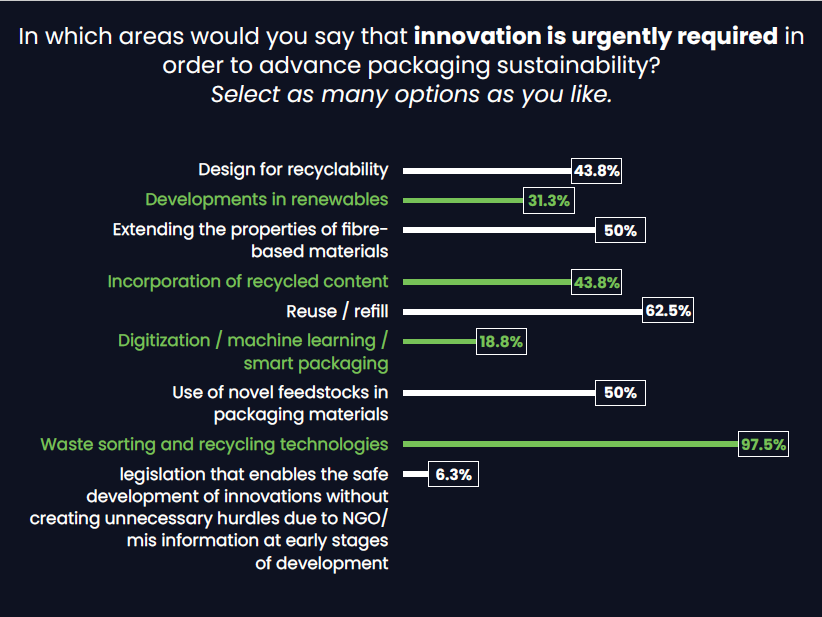
It’s now time to turn to the year ahead; as always, we asked our expert judges where they felt innovation is now most needed, and look at whether this has shifted significantly compared to this time last year. Overwhelmingly, 87.5% of respondents said that waste sorting and recycling technology needs urgent attention to support the burgeoning circular economy, with 75% saying innovation is simply not happening fast enough here.
Just like last year, our judges felt reuse/refill should be accelerated, but as we discussed, innovation may not be the priority here so much as developing the systems to support this. Other major areas to focus on included extending the properties of fibre-based packaging (50% of respondents) design for recyclability (43.8%) and incorporation of recycled content (43.8%). Less urgent, though still significant priorities included, in order, developments in renewables, digitization/ machine learning and legislation to enable all the above.
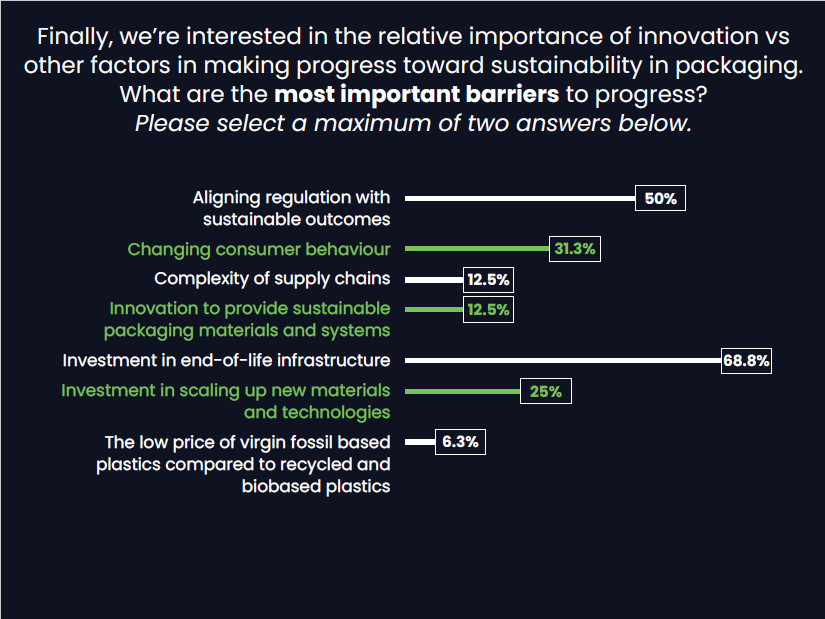
Finally, moving away from individual innovations, we asked our judges about the relative importance of other factors in making progress towards sustainability in packaging. What did they feel were the wider barriers to progress? Most popular responses included:
- 68% felt there needs to be more investment in end-of-life infrastructure (up from 63% last year);
- 50% identified the need to align regulation more effectively with sustainable outcomes (up from 37% last year, so this has jumped significantly);
- 31.3% highlighted the importance of changing consumer behaviour (as compared to 37% last year);
- 25% thought we should prioritize scaling up new materials and technologies (a significant drop from 53% last year);
We will of course continue to monitor these trends and more over the coming year. As ever, we encourage our audience to share any innovations you have with us for our website, which is updated on a daily basis. Or better yet, be part of the conversation and enter our 2025 Sustainability Awards!
Sponsored stories

How ATS-Tanner’s banding solutions align with the new PPWR
ATS-Tanner’s banding solutions aim to reduce packaging waste, provide a practical alternative to plastic and improve recyclability. In

How Rollon’s linear systems provide reliability for tertiary packaging
Rollon believes tertiary packaging machinery must perform without fail, showcased by its recent partnership with AMP Automation to develop palletizing

Discover what’s new at London Packaging Week
Packaging has never carried greater commercial responsibility. It influences how consumers perceive brands, how products perform in increasingly competitive markets

Paperworld Middle East partners with FSC to champion responsible sourcing across the region’s paper and stationery industry
Paperworld Middle East, the region’s leading trade show for paper and stationery products, taking place from 13–15 October

Made for Life: How Sappi reveals what trees make possible
What connects an experienced papermaker, the creators of cactus-based leather, the people conserving forests for future generations, and a

The advantages of all-electric adhesive dispensing in modern packaging
Packaging manufacturers are under constant pressure to increase output, reduce operating costs, improve sustainability, and maintain consistent product quality. One

YUTO won 12 international packaging design awards across three global competitions
Driven by the global sustainability trend, the EU PPWR mandates packaging reduction, recyclable design, and restrictions on single-use packaging.

How rPS Food aims to bring circularity to polystyrene packaging
In this edition of the Spotlight, Coexpan (part of Grupo Lantero) details how its rPS Food enables up to 100%
Read next

Your chance to decide the winner of our 2026 Readers’ Award
The nomination period for Packaging Europe’s 2026 Readers’ Award has ended, the finalists have been selected, and now it’

Nemera launches bi-dose nasal spray solution
Drug delivery device company Nemera has announced its DuoSpray bi-dose nasal spray platform, a ‘non-invasive, needle free’ administration

Coveris develops mono-material sleeve with 30% less material for Dr Beckmann
Coveris has unveiled its mono-material sleeve solution developed for Dr Beckmann, said to use around 30% less material than