

In a rush? Click here to read a short summary of this report
Introduction
The 2024 Sustainable Packaging Summit brought together global stakeholders from across the packaging value chain to address the sector’s most pressing strategic and regulatory challenges. From reporting obligations to the future of reuse and circular plastics, the Summit served as a reality check and a roadmap for progress.
Key Takeaways
- Reporting complexity is a barrier – but also an opportunity. New rules like the PPWR and CSRD demand unprecedented levels of data, pushing companies to rethink their systems. Alignment, standardization, and integration of packaging data across supply chains are essential to avoid duplication and confusion.
- Lack of regulatory harmonization is stalling progress. The EU’s fragmented regulatory landscape – such as national labelling rules conflicting with EU-wide requirements – is undermining the PPWR’s goal of creating a single market for secondary raw materials.
- Plastic waste is an economic – not just environmental – challenge. With global recycling rates for plastic under 10%, panellists called for stronger business incentives and infrastructure investment, especially in emerging markets, to drive circularity at scale.
- Paper is promising, but not a cure-all. Consumer demand is pushing a shift to fiber-based packaging, but challenges around barrier functionality, cost, and overengineering remain. Industry consensus: use paper where it makes sense, but stay materials-agnostic.
- Scaling reuse demands cross-industry coordination. Shared infrastructure, harmonized standards, and consumer incentives are all critical.
- Collaboration and pre-competitive cooperation are essential. Across all discussions, the theme of joined-up thinking – between governments, NGOs, brands, and recyclers – emerged as the only viable path to meaningful change.
Conclusion
The Summit highlighted that sustainable packaging is as much a systems challenge as a technical one. Regulation is setting the pace, but the private sector must drive innovation, transparency, and collaboration. The industry has the tools – but scaling impact will depend on shared standards, smarter investments, and a willingness to think beyond business as usual.
The ambition of the Sustainable Packaging Summit is to facilitate alignment and build a critical mass to drive impact. This report gives summaries of the strategic discussions that took place at the event and some of the key points raised.
The Sustainable Packaging Summit seeks to address the most pressing challenges facing the industry and bring all the key players – including the FMCG value chain, along with NGOs, regulators, EPR, investors and recyclers – together to discuss solutions.
The panel discussions at the 2024 Sustainable Packaging Summit gave visitors a chance to engage with some of the biggest strategic issues facing the industry. Here, we summarize the issues identified during each of these discussions and – more importantly – look at the next steps to take. (For those who are interested, following the report we list the participants in each panel.)

The reporting headache
‘Nightmare’, ‘Challenging’, and even ‘Tsunami’ - just some of the words used by our audience when we asked them to sum up their feelings about the new reporting requirements and targets faced by the packaging value chain.
The recently-introduced PPWR alone has reporting requirements on 22 relevant packaging categories for metrics including recyclability, recycled content, reusability, and more – not to mention the various different EPR schemes around the world that will need to be complied with.
And beyond this, the Corporate Sustainability Reporting Directive introduced in 2023, and the Science Based Targets initiative coming into play, add further layers of complexity to reporting obligations. In most cases it will require a complete overhaul of companies’ packaging data structure, including how they analyze, report and, most importantly, exchange data with the value chain.
But while daunting, these standards also present an opportunity for positive change and even – dare we say it – business growth. This is not the time for the value chain to bury its collective head in the sand. Our panel aimed to help our audience understand the scale and urgency of the reporting challenge, and here we give a summary of the key points, questions and recommendations raised.
- Alignment and standardization are vital: There was agreement among the panel that there are still too many unknowns when it comes to reporting requirements and stakeholders are not starting from a level playing field.
According to one panellist: “You’re asking a supplier to give you data, but what data should they give you? A retailer would not have as much data – or the same data – as a brand would; and then you think about importers who don’t even know that they have to report in some cases. The gap is huge.”
There was also a suggestion that the number of voluntary commitments introduced over the years prior to the PPWR (for example the EMF Global Commitment, Plastic Waste Coalition of Action etc), while important and necessary, do mean that the industry is not beginning with a harmonized reporting standard and that is something that needs to be addressed.
- Data sharing and confidentiality are not mutually exclusive: The need for companies to share their learnings with the value chain to build a more sustainable industry was a key theme of the 2024 Summit. The data reported and distributed along the needs to be accurate if it is to fulfil this purpose, but at the same time brands will naturally be concerned about maintaining a certain level of data confidentiality.
The panel broadly agreed there are ways to address this, one suggestion being that there may be a role for industry platforms – such as CEFLEX or GS1 – to help corporates share the necessary data while protecting IP. Other examples given were Forum Rezyklat in Germany, which has its own dedicated data workstream; or the Open University of Manchester, UK, with its Open3P standard which could fulfil a similar role.
- Collaborate with suppliers constantly: Collaborating with suppliers to share data on metrics like recyclability ‘can’t be a once-a-year outreach’, as one panellist put it. It needs to be proactive and it needs to be continuous; indeed, in future it is suggested that it might be more beneficial to talk pre-competitively with supply chains rather than ‘retrospectively trying to repair damage’. A concrete example given of a valuable tool for this purpose is the ReCyclass platform.
- Find the right IT solution: Many suppliers are trying to react to the reporting challenge using IT solutions that are no longer fit for purpose. Henkel’s Philippe Blank commented: “Companies are employing four or five people to help them gather data when I firmly believe that there are systems out there that are incredibly specialized in collecting the data you need in the most effective way. You could not go into sorting your accounting issue with the wrong software; don’t try to pigeonhole your packaging data challenge into a system that is not built for packaging data.”
The key, he says, is for a company to tailor packaging data collection to the company’s core business processes. “The solution cannot be to have an additional software for packaging that gathers all this data; it has to be a flexible system which seamlessly integrates with what the company already has and can collect data from all the different pools”
An example given was that of Proctor & Gamble harnessing the Microsoft Power BI technology that allows the international giant to zoom in on data at a granular level, including by country, brand or even material.
- Does it matter when the data is collected? The panel discussed whether data should be collected prior to the packaging development phase, rather than after it has appeared on the market.
“This way we could get it right first time. This is almost in some ways being driven by legislation. For the plastic tax, for example, you have to know at the design phase what your products contain, so the point of sale at which everybody would collect their EPR data report is now too late.”
- The first step is the hardest: Put quite simply, if there is inertia on this issue it may be that many companies just don’t know where to start. What, then, is the final advice from our panel?
“Conduct a gap analysis to see what processes and data systems you have right now and what are missing, and then match that with what is available on the market. After all, there may be a lot of unknowns in terms of recyclability standards and all the data fields that we need, but how the infrastructure will need to evolve is at least pretty clear right now.”

Navigating regulatory landscapes
So far we have talked about the new data reporting requirements, but that is only part of the regulatory obligations the industry as a whole faces. One major topic addressed at the 2024 Summit was the uncertainty around regulation and the impact this has on the value chain.
When we polled the audience during the panel discussion on this subject, a whopping 67% of them said they were concerned about their ability to meet goals when it comes to supply chain transformation, recyclability at scale / infrastructure harmonization, and a single market for secondary materials, some of which we will address in more detail below.
One thing to point out: the talk was not so much of what the legislation itself consists of – we can assume that most of our audience are familiar with their obligations now – but where the perceived challenges and bottlenecks are, and how these might be addressed.
We should also point out that the discussion was broadly Euro-centric in term of the regulations discussed, but of course the same challenges around packaging and packaging waste exist all over the world. At our 2025 summit we are looking to widen the lens even further to give a more global perspective on the challenges we face.
Below, again, we give a summary of some of the main points raised during this discussion.
- Creating single market for secondary raw materials: According to panellist Francesca Stevens, Managing Director of EUROPEN, one of the most vital steps to building a single circular economy across Europe through regulation is creating a single market for secondary raw materials. She noted various barriers to this, including the recently revised waste shipment regulation which still impedes the free movement of waste – even non-hazardous waste – across Europe to some extent.
She highlighted the fact that major investments have been made in areas like Eastern Europe in recycling harder to recycle materials, but “What happens if there is no collection and that waste doesn’t move across borders? Harmonization in this area remains, for us, the weakest point of the PPWR.”
- Can the Circular Economy Act address this? In light of this challenge, the panel discussed the proposed Circular Economy Act, posited to come into effect in 2026. One of the main purposes of this will be to drive organizations to completely rethink their resource use and create a business case for secondary raw materials. The much-anticipated Draghi Report, while sobering in its assessment of Europe’s competitiveness in the international environment, did lay out steps for financially incentivizing decarbonization – all the more important given trade tariffs being introduced by the new Trump administration in the US. Pretty much all agree that this will be vital for the continent’s future and all regulation must be geared towards it.
The major competitiveness challenges facing Europea industry means some are starting to ask for protectionist measures, which could also be an impediment to the success of the PPWR.
Then there have been examples of some countries, e.g. Spain, introducing national labelling obligations for household waste, which could create a clash with the PPWR requirements and stand in the way of harmonization. It remains to be seen if this will be the case.
- Major EPR Implications: Articles 44-47 of the PPWR introduce extended producer responsibility (EPR) for packaging producers, such as in the form of financial participation in the costs of collecting, sorting, and recycling packaging waste. But what are the concerns when it comes to implementing this in practice?
Panellist Joachim Quoden of EXPRA, the Extended Producer Responsibility Alliance, suggested that far too many companies are still holding back to understand how the rules will be implemented in other member states.
From the brand owner perspective, according to Nestle’s Jodie Roussell, “We operate in 188 countries and so, globally, we’re looking at 80 EPR regulations that are written and are in force; 35 that are in draft. Combine that with the PPWR, which goes a lot farther, and the shift from voluntary to mandatory commitments is a huge undertaking. We’re eagerly waiting to see what the results will be, like the secondary legislation on design for recycling.”
- The question of secondary legislation: Beyond the various derogations and exceptions, one of the most commonly mentioned downsides of the PPWR seems to be the number of items in secondary legislation relating to waste, shipments – the list goes on.
According to Francesca Stevens: “We heard about tsunami of legislation when we had the Green Deal on the table; now we are talking about a tsunami of secondary legislation – reaching up to the hundreds.”
For the Regulation to be successful in the task it has set out to achieve, this secondary legislation must be adopted in a timely manner on a ‘factual and scientific basis’, but with limited time between legislative cycles and competing interests and priorities, this is no small task for those involved to address.

Global supply chains for circular plastics
At the start of our panel session on this topic, moderator put a multiple-choice poll question to the audience: Annually, the equivalent of how many half-litre plastic bottles end up as litter in the global environment: One billion, ten billion, 100 billion or one trillion?
The most popular response given was 100 billion, but sadly, the answer is actually one trillion. It’s a gloomy figure, and also raises the question: if a roomful of experts in various facets of the packaging supply chain can underestimate the scale of the problem, is it any wonder that the wider world, and consumers, have taken so long to recognize the urgency?
We know that negotiations for a legally binding Global Plastics Treaty are ongoing as we speak, but the issues involved are complex. As we shall see, building global supply chains for circular plastics is about practical solutions – financial, economic, changing the narrative for consumers. Here are some of the main strategic points raised during the panel:
- Plastic waste is an economic problem: According to panellist Vikas Chhajer of Gemini Corporation, plastic waste can primarily be viewed as a financial challenge. “Gemini sees the circular economy and recycling as a business. 70 percent of aluminium ever produced is still in use. 70% of steel ever produced is still in use. More than 60% of paper that is used is recycled. Compare this to the global plastic recycling rate, which is less than 10% and actually decreasing. For us, it is not a sustainability or a circular economy problem but an economic one first.
“So for steel, for aluminium, for the paper industry, the waste that is generated is their feedstock which means the collection and sorting is supported by the same industry. But for plastics, it comes from petrochemicals, and the petrochemical companies have never taken back the waste yet. Hopefully they will be doing it in future when advanced recycling or chemical recycling become commercially viable. But nobody is sponsoring that collection and sorting part. That’s the first and the biggest challenge: providing feedstock to recycling or reuse or any kind of a circular system. It’s about scale.”
- Where does investment come from? Representing the voice of venture capital, Regula Schegg from Circulate Capital discussed how as an impact-driven investment firm based in Singapore it has seen the opportunities there are in emerging markets where the leakage of plastic into the ocean and waterways is most severe.
The challenge is that “we need about 17 trillion up to 2040 to build the infrastructure needed. And the fact is that the governments are very limited, particularly in the emerging markets with the different agendas they have to fund those infrastructure developments. That money will likely have to come from institutional investors around the world.”
- The importance of on-the-ground investment: Raffi Scher from Prevented Ocean Plastics spoke about how the right investment can also enable grassroots organizations to be part of the solution – and indeed how this sector presents real opportunities.
“At Prevented Ocean Plastic, we are essentially creating a franchise model at the collection centre level in at-risk coastal communities. We have a long-term relationship with Circulate Capital and we were recently able to open East Borneo’s first major plastic collection centre, at 600 tonnes per month. We’ve also opened our first major plastic collection centre in East Africa in Tanzania. What these collection centres do is create a repeatable and ongoing model. We want to make sure that just like there’s a McDonald’s or a Starbucks almost everywhere you go, every coastal region has a collection centre that’s fit for purpose.”
- Creating a market for flexibles: While Prevented Ocean Plastics is an enterprise focused on building a circular economy for PET in emerging markets, Wild Plastic is focused more on the challenge of bringing flexible plastics in the environment back into the circular economy.
According to Wild Plastic’s Christian Sigmund: “There is still not really an offtake market for flexible recycled, especially in emerging markets and when recovered from the environment. We have to create this, and we have to create it now. We work with amazing organizations like VCAs in India and other regions of the world to recover, sort, and prepare flexibles for recycling and then find the offtakers who make this all possible. If there is no offtake, there is no collection. One example we can give is the German online retailer Otto Group: since January 2024 100% of their mailing bags are made from recycled recovered plastic.”
- Look upstream as well as downstream: So far we’ve focused on the downstream part of the supply chain, but the solution also needs to encompass upstream processes such as, of course, reuse. Rather than focus on the Global North, our panel was keen to highlight some of the successful systems that are already functioning in the Global South. Coca-Cola, for example, has the most advanced markets for reuse and refill in Latin America. There is also the example of Mercado Circular from Chile and Mexico, which run refill systems in malls and subways.
Again, says Vikas, whether or not reusable plastic takes off comes down to economics: “In the last 30 years, with the economic growth globally in developing as well as developed countries, as plastic consumption increases the material itself has become cheaper and cheaper, so the reuse part became more expensive. Now we are starting to take note of the huge costs that future generations will pay that has to be included in balance sheets now. It’s helping to drive the shift towards reuse.”
Even further upstream, there also needs to be more focus on prevention in the first place – or ‘turning off the tap’, as it has famously been put, and reuse will play an important role here too (as we see in more detail further down). All plastics should be included in this, but particularly problematic and unnecessary ones.
- Changing the narrative for consumers? Many consumers today see renewables as the default ‘sustainable’ choice, and it’s not surprising given the very visible plastic waste problem. It’s important, said the panel, to understand consumers’ concerns about plastics but also to create a more positive conversation around them. To demonstrate the ways in which plastic can sometimes be the more sustainable choice, and how the industry is working to develop the infrastructure to support circular plastics. Right now, this isn’t being communicated enough and it’s up to brands, NGOs and other stakeholders to be proactive here.
- Social impacts: While the main strategic focus Summit was on sustainability, there was also discussion of the social impacts of moving towards circular plastics. The panel agreed it is important for all stakeholders to ask what can be done in developing countries to fight against child labour in waste collection, as there is an undeniable tension between what the world is trying to do to divert plastic waste and the social consequences for the most vulnerable people.
So what can companies involved in these areas do? Among other things: ensure you understand where all the material in your supply chain is coming from; ask questions and be strict about where you are buying from; if possible, invest in building your own collection centres; implement digital solutions so you have full transparency and traceability.
- Increasing availability of food-grade plastics: Food grade plastics currently still makes up less than 10% of the recycled plastic globally, and this is a significant barrier to circularity and areas like reuse or refill, which are particularly suited for food and drink applications. Europe has been a frontrunner in the supply of rPET food grade and regulations have helped here, but it’s the same old story in that sorting and collection infrastructure is still lacking.
Elsewhere, according to the panel, many countries in Asia did not even legally allow food grade rPET until about two years ago. It was also suggested that there should be greater focus on biobased food grade plastics to replace virgin oil-based plastics.
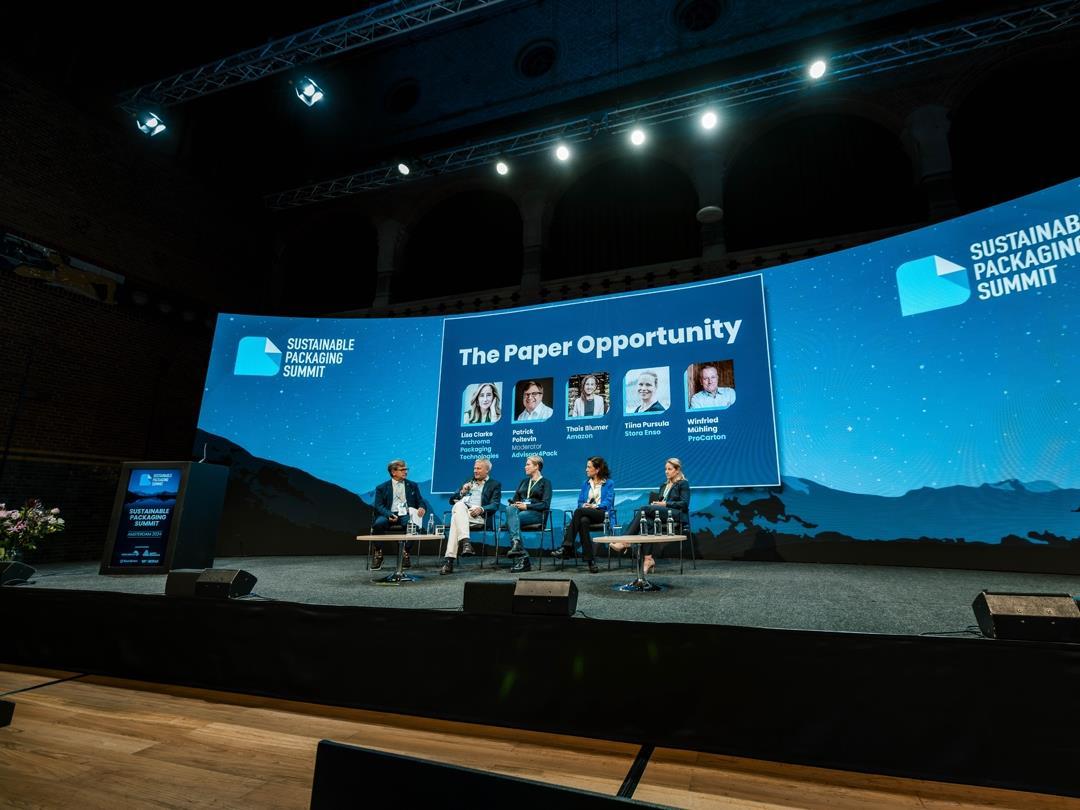
The paper opportunity
The migration from plastic to paper for certain applications has been one of the really notable shifts we’ve seen in the market over the past two to three years, with increasingly sophisticated barrier solutions to expand the range of applications. But it’s by no means a clear-cut issue: some are vociferous about the need to shift to paper; others are equally emphatic that we should be focusing our efforts on circular plastics.
The majority are perhaps somewhere in the middle. This uncertainty was reflected in the results of a poll we launched to start this session, which asked: ‘Does the paperization trend offer a net environmental gain’? 43% said yes, 24% no, and 33% were undecided.
In the session, our panellists explored what is driving the paperization trend – although our moderator preferred the term ‘fiberization’ as we also include cartonboard within this – and the environmental considerations around switching to a renewable packaging material. Here were some of the key topics.
- What is driving paperization? To set the context a little, our panel talked about why we have seen such a notable shift towards fibre-based packaging in recent years. First, it’s undoubtedly the case that consumer demand for these solutions is increasing as it’s perceived as less harmful to the environment, more ‘natural’, easier to recycled and so on. The Covid pandemic may have hastened this, with increased reliance on e-commerce forcing consumers to confront the topic of packaging materials.
One of our panellists, Amazon’s Thais Blumer, pointed out that customer feedback was directly behind the company’s increasing shift towards paper. “A few years ago Amazon ran some surveys with customers and 50% said they would be happy to receive their orders without added packaging, but if packaging was required then their number one priority was that it must be recyclable.” This has resulted in a gradual shift from single-use plastic bags and pillows to fibre-based packages wherever possible.
- Barrier functionality remains a major challenge: If you were to ask anyone in the industry what the biggest hurdle to the adoption of paper-based packaging is today, many would likely cite insufficient barrier functionality as the main one. Indeed, when we polled our audience with this question it was this that came out on top – although the perceived high cost of transition to paper also seemed to be a concern.
To give a fibre-based package barrier functionality, particularly for more demanding applications, a coating is required and this will often include plastic elements. One focus for the industry is therefore to reduce the amount of plastic required in coating and increase the share of renewables.
If we look at it from the paper producer side, when it comes to barrier functionality, pointed out panellist Tiina Pursula from Stora Enso, it’s key to collaborate with the value chain to ensure the package is not over-engineered; “The lighter the barrier, the better it fits the recycling system”. This means looking at products on a case-by-case basis to understand how strong a barrier is needed.
She also took the opportunity to point out that it is “A myth that laminated barrier papers are simply not recyclable. Stora Ensa is a major recycler and we have in Belgium, Poland and Finland large-scale mills utilizing recycled paper and board as a raw material in all sort of mixed grades, recycled at scale.”
Bio-based coatings are another area in which we will see increased progress in the years to come and these will further bring barrier papers into the mainstream.
- Understand the limits of paper: We’ve all heard – and I daresay repeated – the mantra: paper where possible, plastics where necessary. Because sometimes paper is simply not a feasible option and the industry needs to recognize this and be materials-agnostic in its attitude.
Panellist Lisa Clarke from Archroma Packaging Technologies gave the perspective from the chemicals angle: “Our goal is to create more sustainable chemistry whatever the substrate and the type of coating – whether that be flexible plastics, or paper-based packaging. The challenge is that many who want to switch expect the same performance out of paper that they get from plastic but there’s really a lot more complexity behind the coating technology. Some customers may have specific temperature requirements, others for oil and grease resistance – it’s really understanding the particular customer need for that application and using the best material for each case.”
From the online retail perspective, Amazon’s Thais Blumer adds: “Many believe that Amazon transitioned in Europe from single-use plastics only to paper, but the reality is not so simple. We have seen a lot of success in paper in some areas but in specific cases – such as some grocery products – we still need stronger barrier protection from plastic. We are actually in the process of testing biobased materials for this purpose in Spain, but then we need to think about how we enable the infrastructure for collection and recovery in this case so we don’t just throw these new innovative materials in the bin and hope for the best.”

Reuse consortiums
The need to scale reuse is ever-more pressing and we are running out of time. By 2030, 20% of cold and hot beverages will have to be filled in a container that is part of a reuse system, and by 2040 this figure rises to 80%. For takeaway-prepared meals, the targets are 10% in 2030 and 40% in 2040. Finally, 10% of e-commerce transport packaging must be reusable by 2030 and 50% by 2040.
This is not to mention the packaging reduction targets for member states, which will reach 15% by 2040 against the 2018 baseline. A considerable amount of this will need to come from reusable systems. To just give one of the many examples we could cite of the opportunity reuse represents: according to research by the World Economic Forum, reusing just 10% of plastic products would reduce the amount of plastic waste reaching the ocean by 50%.
In our previous members’ report we looked at some of the more recent innovations we have seen in this field, but the focus now is more on how the various elements of the supply chain can work together and join up the dots to implement such innovations on wider scale. Hence, the panel discussion on this subject at the Sustainable Packaging Summit included representatives from reuse consortia – alongside other stakeholders such as brand owners – to grapple with the strategic issues around scaling reuse.
- Harmonization of definitions and data is key: According to panellist Holly Nelson from Unilever, one of the key points the Business Coalition for a Global Plastic Treaty is advocating for is harmonization around definitions and labelling of reuse and refill – and more crucially, therefore, around how we measure it.
This would also help to address the urgent need for standardization of data around reuse.
According to Avery Dennison’s Noam Assael, “It’s important that in a reuse system you need to share information with other companies and actors in the network. Once we start working with standards that are developed by e.g. PR3 or GS1, information such as understanding what vessels have been washed or lost along the way all helps us to create more efficient, cost-effective systems. So any initiatives, like GS1’s Sunrise 2027, that add RFID tags helps to create a connected ecosystem we can all build on.”
- Is standardization the way forward? One of the big questions now being asked around reuse/refill is whether the industry needs to move into an era of standardized systems and packs. Just one example of this is Orora Packaging Solutions’ Jarbot reusable system (a recent Sustainability Awards nominee), which is comprised of seven stock keeping units (SKUs) that can be shared amongst brands to help fuel the circular life cycle of the product’s packaging, with customizable decorative labels for each brand.
The positives to this are obvious – greater efficiencies, fewer SKUs, simplifying the in-store experience for consumers – but there are also other considerations. For one thing, how does antitrust come into play when we look at shared pool packaging, and what about the tension between standardization and brand differentiation?
For Holly Nelson, there are other ways a brand such as Unilever can compete: “Labels…the actual product itself and the benefits it can bring to the consumer as well as other incentives for purpose-built brands we have. Packaging is not the only way to differentiate anymore.”
- Incentivizing consumers to participate: A major barrier to reuse has always been getting consumer buy-in, and we’ve discussed this many times over the years. It’s complex but, in essence, it comes down to convenience and incentivizing the consumer to go that extra mile – whether that’s taking an empty pack back to store or taking a super-concentrated formula home and diluting it.
One talking point when it came to consumer convenience was reverse logistics, or – as some are apparently now referring to it – ‘system performance’. The Tesco Loop trial in the UK two years ago concluded that consumers are on the whole still reluctant to return containers to supermarkets in sufficient numbers to tip the scales. What, then, if ‘the supermarket comes to us?’ If companies such as DHL or FedEx came to people’s homes to pick up their reusable containers and take them to shared washing and sorting centres, how much CO2 could this save? It’s a question worth exploring.”
- Learnings from pilots: Another theme of the Summit was stakeholders being willing to share their learnings from pilots and other studies t help the industry meet its collective goals. To demonstrate the importance of this, Holly Nelson shared some of the over 50 reuse pilots Unilever alone has been involved in and what they garnered from these.
“In emerging markets, we need to start funnelling more investment from both the private and public sector into building reuse ecosystems and the lack of data is a missing proof point to start channelling that investment. There are spaces where this is working when we have the right partnerships across the value chain: in Indonesia, for example, we have over 1000 reuse stations in place on a very simple refill principle, working with the likes of Alner among others and we’re using that to educate consumers and bring them together.
“A different example I can give is our OMO brand in Latin America – a six-times concentrate laundry liquid that uses around 70% less plastic. The crucial reason this pilot has been successful is not because it’s been branded to the public as a sustainable solution, but because of its affordability.”
And what about key learnings from less successful trials? “We’ve learned that, in-store, for things like concentrates where the volume Is really small compared to an average product they lose out on visibility. So one of the key learnings from refill in stores is that you need a multi-category approach, where the consumer can walk into a store and can buy multiple brands in multiple product categories in exactly the same way.” Again, the need for standardization rears its head.
- How regulation can foster positive change: Regulation does not have to – and indeed should not – be seen as a millstone. The panel broadly agreed that regulation, when not targeting individual groups, can serve to level the playing field and encourage vital pre-competitive cooperation in terms of packaging design and shared infrastructure.
On the one hand, as we have seen, policy can trigger very radical changes, such as in France where the banning of single-use cutlery in restaurants led almost overnight to business moving to reusable solutions. On the other hand, policy, as one panellist pointed out, “can help build incremental change if it enables a period of collaboration without very strict targets as it leaves space for innovation.”
Final questions
Looking at all the strategic areas above, we can see that there are many overlaps in terms of what the industry needs to do. When summing up the overall ambitions expressed at the 2024 Sustainable Packaging Summit, Bruno Van Gompel, Board Member, founder of VGV Management Services and all-round packaging / sustainability sage, set the scene by suggesting there are five key questions each company needs to ask itself to really get the maximum from its sustainability strategy:
1. How are you going to continue the momentum? Yes, we’re working in a challenging business environment where consumers are spending less money. Remember, if we miss the opportunity to embrace sustainability today, we’ll make it harder for ourselves in the future.
2. Do you see a future where sustainability is a competitive advantage? How do we find the right balance between sustainability and competitiveness, not just in Europe but globally? What actions will you take?
3. Are you ready to convert regulatory challenges into opportunities? There is a tsunami of regulations coming our way, and not just PPWR. How do we turn compliance into a positive? A great example is the CEFLEX - A Circular Economy for Flexible Packaging consortium; changing the entire business model for flexibles from the bottom up.
4. Are you prepared to scale successful pilots into industry-wide solutions? We’ve heard many great stories following completed pilots, whether that’s in renewables, reusable packaging systems or sorting technologies – but what do we do to make these a reality? Bruno suggests: “Rather than calling something a pilot, why not call it ‘the first phase of a roll-out? Be positive.”
5. Are you willing to share your learnings to address all these challenges? For pre-competitive alignment, we now need true collaboration across the supply chain and the value chain, and that means sharing what you’ve found on your sustainability journey. Are you operating in a silo, and if so how can you move out of this? Encouragingly, around one-third of the Sustainability Awards presented last year were to companies working in tandem to come up with solutions. Long may this continue.
Supplementary information: List of Strategy Stage speakers
The reporting headache
Moderator: Renata Daudt, AWEN Packaging Consulting
Speakers:
- Philippe Blank, Henkel (may be replaced by a colleague)
- Alexander Reitz, PreZero Sustainable Packaging
- Michelle Carvell, Lorax Compliance
- Trevor Yong, Aura
- Mathilde Taveau, Plastics Recyclers Europe
Navigating regulatory landscapes
Moderator: Hans Van Bochove (Heineken)
Speakers:
- Joachim Quoden, EXPRA
- Jodie Roussell, Nestlé
- Francesca Stevens, EUROPEN
- Wolfgang Trunk, European Commission
Global supply chains for circular plastics
Moderator: David Jakubovic
Speakers:
- Vikas Chhajer, Gemini Corporation
- Raffi Schieir, Prevented Ocean Plastics
- Christian Sigmund, Wild Plastic
- Willemijn Peeters, Searious Business
- Laura Griestop, WWF Germany
- Regula Schegg, Circulate Capital
The paper opportunity
Moderator: Patrick Poitevin
Speakers:
- Thais Blumer, Amazon
- Winfried Mühling, ProCarton
- Tiina Pursula, Stora Enso
- Lisa Clarke, Archroma Packaging Technologies
Reuse consortiums
Moderator: Lindy Hughson
Speakers:
- Emmanuelle Bautista, CITEO
- Amy Larkin, PR3-RESOLVE
- Feng Wang, UNEP
- Holly Nelson, Unilever
- Mirjam Karmiggelt, GS1 Netherlands
- Noam Assael, Avery Dennison
If you liked this story, you might also enjoy:
Reuse vs. single use – which is better for the environment?
Sustainable Innovation Report 2025: Current trends and future priorities
What can the world learn from South Korea’s world-leading performance in plastics circularity?
Sponsored stories

How ATS-Tanner’s banding solutions align with the new PPWR
ATS-Tanner’s banding solutions aim to reduce packaging waste, provide a practical alternative to plastic and improve recyclability. In

How Rollon’s linear systems provide reliability for tertiary packaging
Rollon believes tertiary packaging machinery must perform without fail, showcased by its recent partnership with AMP Automation to develop palletizing

Discover what’s new at London Packaging Week
Packaging has never carried greater commercial responsibility. It influences how consumers perceive brands, how products perform in increasingly competitive markets

Paperworld Middle East partners with FSC to champion responsible sourcing across the region’s paper and stationery industry
Paperworld Middle East, the region’s leading trade show for paper and stationery products, taking place from 13–15 October

Made for Life: How Sappi reveals what trees make possible
What connects an experienced papermaker, the creators of cactus-based leather, the people conserving forests for future generations, and a

The advantages of all-electric adhesive dispensing in modern packaging
Packaging manufacturers are under constant pressure to increase output, reduce operating costs, improve sustainability, and maintain consistent product quality. One

YUTO won 12 international packaging design awards across three global competitions
Driven by the global sustainability trend, the EU PPWR mandates packaging reduction, recyclable design, and restrictions on single-use packaging.

How rPS Food aims to bring circularity to polystyrene packaging
In this edition of the Spotlight, Coexpan (part of Grupo Lantero) details how its rPS Food enables up to 100%
Read next

Your chance to decide the winner of our 2026 Readers’ Award
The nomination period for Packaging Europe’s 2026 Readers’ Award has ended, the finalists have been selected, and now it’

Nemera launches bi-dose nasal spray solution
Drug delivery device company Nemera has announced its DuoSpray bi-dose nasal spray platform, a ‘non-invasive, needle free’ administration

Coveris develops mono-material sleeve with 30% less material for Dr Beckmann
Coveris has unveiled its mono-material sleeve solution developed for Dr Beckmann, said to use around 30% less material than