

In a rush? Click here to read a short summary of this report
Introduction
This report explores the persistent challenges preventing the mainstream adoption of reuse and refill packaging systems, despite growing consumer awareness and regulatory momentum. By examining policy, design, supply chain, and consumer behaviour, it outlines how industry players can overcome the current fragmentation and scale reuse models effectively.
Key Takeaways
- Terminology confusion is stalling progress: Industry and policymakers often use “reuse” and “refill” interchangeably, despite them requiring different systems and strategies. This lack of clarity leads to misaligned goals, failed pilots, and even greenwashing.
- Fragmented regulation impedes scale: Inconsistent policies and competition laws across regions limit collective industry action. Stronger, harmonized legislation—like binding reuse targets and EPR schemes—is needed to de-risk investment.
- Supply chain collaboration is essential: Shared infrastructure, standardization, and upstream engagement are critical for viable reuse models. Projects like the Refill Coalition demonstrate the benefits of coordinated B2B systems.
- Consumer participation hinges on simplicity and cost: Despite widespread environmental concern, only 22% of consumers prioritize reusable packaging. Effective systems must be user-friendly, price-aligned, and supported by loyalty schemes or smart technologies.
- Brands fear investment risks: Many companies hesitate to commit due to high setup costs and inflexible infrastructure. De-risking through shared standards or government-backed incentives could encourage broader participation.
- Reuse is not a silver bullet: It must be implemented strategically, with a clear understanding of environmental trade-offs and durability thresholds. Poorly designed reuse systems can fail both economically and ecologically.
Conclusion
The shift from single-use to reuse and refill systems requires systemic change—not just from consumers, but across policy, infrastructure, and corporate mindset.. To succeed, companies must think long-term, invest in innovation and upskilling, and be prepared to lead—not just follow—the transition.
In our latest report, Victoria Hattersley surveys the current reuse/refill landscape, asking: What are some of the main industry-wide challenges preventing wider uptake, and how can companies make a start?
Back in November 2023, when we surveyed our Sustainability Awards jurors about where innovation is most urgently required across the packaging industry, the ‘winner’ – an inappropriate term, some might say – was reuse/refill, with 53% naming this as the top priority.
This comes as no surprise. It is now recognized that reuse and refill must play a much bigger role in the circular economy moving forward if the industry is to achieve its Net Zero goals, while also tackling the ever-growing issue of plastic pollution. (Not, of course, that reusable and refillable packaging is confined to plastics alone.)
Stricter policies and regulatory requirements are clearly going to be key to bringing about the changes needed to scale reuse – it is, as we have noted in a previous report, a major element of the ongoing negotiations around the Global Plastics Treaty, although individual governments also have their roles to play.
That being said, work has already begun through voluntary cross-value chain initiatives, most notably the Ellen Macarthur Foundation’s Global Commitment whose most recent update tells us that 20% of packaging producer, brand, and retailer signatories have increased their percentage of reusable plastic packaging in 2022.
This same report does, however, state that half (53%) of the signatories reported having no reusable plastic packaging as of 2023. Single-use packaging still dominates. Why is this? Why do some of the very innovative reuse and refill startups we see so often find it difficult to scale or translate to systemic change?
This article sets out some of what we see as the major barriers to scaling reuse and refill (our readers, no doubt, will be able to identify more, in which case we always welcome your input – this is supposed to be a dialogue, after all).
For each of the barriers discussed we will look at why it exists, but then more importantly how industry and legislators are creating, or can create, the enabling conditions to address it. Some of the means to address these are in the power of individual companies; some in retail settings; some rely more on wider infrastructural changes; some on policy makers; some through collaboration – most will be a combination of these.
We will conclude – as we like to do – with a brief, more practical look at how individual companies can make a start on their reuse journey.
Barriers to reuse
“You can see where the confusion lies, and why greater clarity is needed.”
Lack of clarity around definitions
In order to tackle a problem we must first know how to discuss it. And so we start with the fact that there is still, even now, a great deal of confusion around the terms we use when we talk about reuse and refill – and not just among consumers.
At the most fundamental level, says Stephanie Northen, PhD researcher in microplastics and Research Associate for Revolution Plastics and the Global Plastics Policy Centre at the University of Portsmouth, there is still a tendency in some areas to use reuse and refill interchangeably, when in fact they require very different approaches.
A project Stephanie was recently involved in with the Global Plastics Policy Centre researched the subject and published a (very comprehensive) analysis of reuse strategies currently available entitled ‘Making Reuse a Reality: A Systems Approach to Tackling Single-use Plastic Pollution’. Produced in collaboration with Break Free From Plastic, the report was originally published to aid the INC-2 Global Treaty negotiations but it’s also a great resource for anyone wanting to know more about the subject.
Among many other things, says Stephanie, “the definition and understanding of the term reuse ended up becoming a more central focus of our initial research than we originally anticipated. This is because we encountered numerous different definitions when talking to industry representatives and policy negotiators and it revealed a significant overlap in the terminology.”
It may sound needlessly pedantic to fret about terms, but this is not the case: if there isn’t a basic agreement and understanding of the different definitions of reuse then projects, however innovative they are, are far more likely to fail because their essential purpose becomes opaque. As many are aware, there are four basic types of consumer-facing model (refill at home, refill on the go, return from home, and return on the go) and all require very different approaches and levels of participation from consumers and the industry.
However you look at it, it’s certainly not a case of ‘one size fits all’: What works in a hospitality setting will not work in a retail venue; what works for at-home use will not work for on-the-go. And then if you break it down even further: a bricks-and-mortar retail setting will have different requirements for reuse than an e-commerce sale. You can see where the confusion lies, and why greater clarity is needed. (And for that matter, as an aside – while this is not an issue of definitions, there are also geographical considerations: hot and humid areas, for example, will present greater challenges when it comes to food safety and shelf life.)
“Reuse is often used interchangeably with refill, and refill is often used to describe replenishing reusable packaging,” says Stephanie. “There is even a trend of single-use items that are misleadingly labelled as reusable, for example, thin plastic cutlery in cafes. So, this practice shifts the responsibility onto the consumer. And this is where it’s a problem because it can enable greenwashing by companies.”
Addressing the complexity around reuse and refill systems is not just about clarifying separate definitions though – what if, in future, asks circular economy consultant Chris Baker, some of the above-mentioned customer-facing models could be combined to simplify both the reuse cycle and production itself?
“Look at the refill at home model: there’s no reason why that bottle they’re refilling at home couldn’t also be designed so that in the future it could be used in a return for reuse model or it could even be brought back to the store. And then, look at look at a soda can. They’re all basically the same size and shape so there’s no reason if you have a soda can with a cap on top that the same product couldn’t be brought back to a store and refilled in a machine. That begins to reduce some of the investment risk because people can see that there is going to be some level of standardization across the systems.”
The policy framework
Definitions are not the only area where coherence is lacking. Existing packaging policies and targets across the world are as yet too diverse to facilitate more widespread reuse and refill adoption. In the EU, the revised PPWR is set to include reuse targets for 2030 and 2040 and individual countries (e.g. France, Germany, The Netherlands, Sweden and Poland) are introducing their own legislation.
In the US, there is more of a focus on extended producer responsibility (EPR) schemes and deposit return schemes (DPS). Industry is lobbying on these issues – for example through the Business Coalition for a Global Plastics Treaty – and the ongoing negotiations around the Global Plastics Treaty also include prioritizing reuse models.
Current competition laws are also hindering collective action. “Mandatory binding targets with clear timings are vital to give businesses the much-needed confidence for investment,” explains Tracy Sutton, founder of the packaging circularity agency Root. “Regulation needs to create a level playing field for brands and mature appropriately on anti-competition regulation to create the right environment for competitors to work.”
Anti-competition regulations are also necessary as a way, it is hoped, to foster collaboration by allowing for shared infrastructure, digital platforms and so on. There may also be the opportunity in future to share distribution, cleaning and sorting costs in a shared infrastructure. The point is, individual companies or even individual governments cannot effect the necessary change alone.
To sum up here, according to the University of Portsmouth report cited above, the main policy requirements to enable reuse are:
- Reduction targets for virgin material production
- Reuse and reduction binding targets
- Sector-specific reuse yearly percentage targets
- Sector single-use bans with reusable packaging replacement
- EPR to fully cost single-use materials.
Lack of supply chain coordination
Greater collaboration is sorely needed across the supply chain so that certain processes can be standardized and entire systems can operate more efficiently. Chris Baker highlights a project currently being run by Go Unpackaged, the Refill Coalition, in which members are seeking to co-design a standardized refill solution to get bulk products to the refill machine.
“These systems work economically,” he says, “not just because of the efficiencies you can drive, but you’re more or less guaranteed a 100% return rate on your packaging in a B2B system because it’s locked in. It’s a closed system. So I think focusing on creating that reusable B2B system is critical, but of course in doing so you’ve got to start engaging others in the supply chain and work out how you standardize something as each of the different players in the chain is going to have different criteria that they want that to fit.”
There is also an argument for focusing collaborative efforts further upstream along the supply chain in future, as Stephanie notes.
“Currently we have a very linear process in the way that packaging operates and we know that we can’t keep sticking that band-aid on the wound and focus solely on the downstream issue of plastic waste. We need to shift that focus to the upstream and midstream stages to phase out those problematic pieces of packaging; statistics already show how that 80% of a product’s impact is defined at the design phase.”
Finally, we saw from the entries to our Sustainability Awards last year how the use of smart technologies in the design of reuse systems will aid coordination and efficiency across the value chain. One example is Pragmatic Semiconductor with its flexible microchips (FlexICs), which are embedded in NFC (Near Field Communication) or RFID (Radio Frequency Identification) labels, providing reusable packaging with a unique, item-level identifier – and insights into packaging lifespan, washing efficiency and return rates.
Another solution to mention in this context is Vytal – a smart platform which offers an operating system for B2B2C reusable packaging. Starting with delivery food and to-go consumption, according to the company the Vytal app achieves a return rate of 99% and an average return time of less than 5 days and ‘operates more efficiently than the well-established German beer bottle deposit system’.
”It’s also vital to understand consumers’ priorities – two of the biggest being simplicity and price point.”
Getting consumers onboard
The majority of consumers, if asked, would probably say they want their packaging to be sustainable: one problem here is that what we say and what we do can be very different (the ‘value-action’ gap). It is not surprising, then, that a recent survey by PA Consulting found that nearly four in five consumers (78%) do not prioritize products with reusable and refillable packaging, even though 80% said they believed in the importance of reducing plastics.
Brands and retailers need to find ways to not just persuade consumers that reusable and refillable packaging are sustainable choices, but to actively incentivize them to make these choices. One way to do this is through loyalty programmes, such as that for Yeo Valley’s reusable lids for yoghurt pots.
It’s also vital to understand consumers’ priorities – two of the biggest being simplicity and price point. In terms of simplicity, standardization of refill machines in shops would help consumers get more familiar with these systems and build confidence in using them. Again, smart technologies can also play a role in this regard.
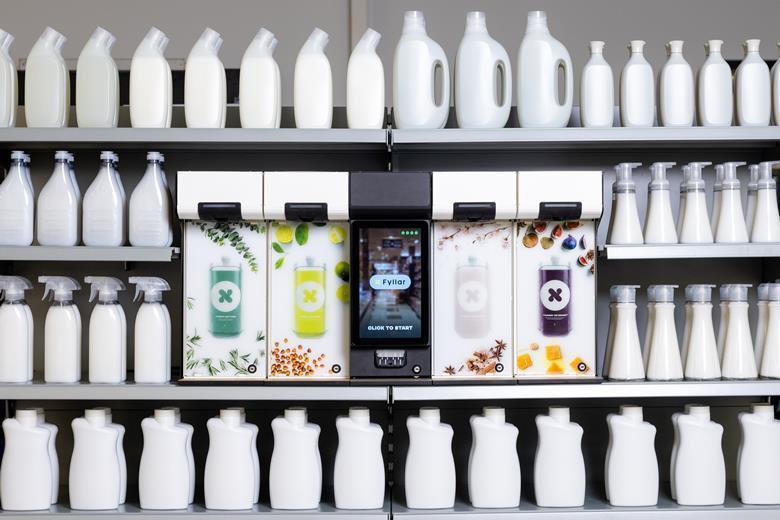
Fyllar, for example – another of the finalists in our 2023 Sustainability Awards – has developed a compact, smart refill system for liquids. According to the company, “Integrated with the smart fill RFID tag, our machines provide a level of intelligence, recognizing different products and ensuring precise, appropriate fills every time. This RFID capability also unlocks endless possibilities; from data-driven reward systems that further incentivize refills, to significant operational advantages that streamline processes and optimize inventory management.”
According to Chris Baker, who recently worked with the company, such systems can really help to address the consumer compliance issue: “An important part of this smart system is the user interface, using a digital screen, using videos and animations on the screen to steer the consumer. What we found worked best was videos of their peers. They don’t want to necessarily see a corporate message. They want to see people like themselves using the machine.”
In terms of convenience, Chris stresses that in-store placement is key. Systems that are focused on following the ‘normal’ shopping route are going to be more successful but too often this is not the case and they are placed out of the way.
And lastly, there is that ever-looming question of cost. Budgets are tight so for a reuse system to work it needs price-parity, or as close to it as possible. How can businesses go about removing the premium for refill?
“Essentially we should be encouraging people to buy the product, not the packaging. The challenge here of course becomes how you get the package back. At the moment, you can in some cases pay quite a large deposit to get the packaging on the first purchase and that can put customers off. I’ve seen interesting models in the hospitality industry where the deposit is already included in the packaging price and when you bring that back you scan the pack and it is automatically refunded to your bank card or a subscription model.”
One of the advantages of having the packaging remain in the ownership of the retailer or company is that it takes the responsibility from the consumer and shifts it upstream which would keep reusable packages circulating for longer and reduce the burden of waste on the communities using them.
Increasing company buy-in
It is not just consumers who need convincing to embrace reuse and refill models; while a growing number of companies are moving into this sphere, many are still cautious about the perceived risks involved. What might be behind this reluctance?
“Set up costs and first-mover risk, combined with data that suggests consumer engagement is low are key reasons for low confidence,” says Tracy Sutton. “The problem is that the stats are often coming from poorly designed pilots that lacked the right holistic expertise at the concept phase. Poor design drives poor results. A lack of expertise across the reuse value chain reduces confidence to invest in the right projects. We mainly have pockets of expertise focusing on their own siloed priorities – we need to address reuse holistically.”
The question of set-up costs touched upon above can certainly be a big stumbling block. As Chris points out, brands don’t entirely ‘own’ the process from design to packaged product – rather they are tied to lots of infrastructure along the way, the most visible of which is packaging filling lines.
“High-speed filling lines for packaging are set up in a certain way to run a certain type of pack down the line, and changing these to fit a reuse or refill system is going to require companies to make changes. The problem is there is no clear winner yet on the reuse systems and not enough flexibility between systems because they all use different kinds of packaging (single use-type packs for return models, for example, or bulk containers for refill in-store models). Investing heavily in one particular system then comes with the risk that a company will only have to change it again further down the line.”
With this prospect of locked-in capital, it’s easy to see why brands may be reluctant to be the ones to make that ‘first leap’. Again – at the risk of labouring a point – the value chain needs to think collaboratively, systems need to be standardized and the playing field needs to be levelled (the spectre of competition laws rears its head again) in order to hopefully share that risk.
Either that, or there have been suggestions that first-movers could in certain cases be compensated by governments or multi-stakeholder initiatives so the ‘risk’ element is effectively eliminated.
A last point: upskilling. “Upskilling teams is vital to make the right, informed decisions from strategy to implementation,” says Tracy. “You must have full business buy in from commercial to c-suite to make sure you progress past pilot. Marketeers bring huge potential but are lacking confidence because they are fearful of greenwashing.”
Lack of investment
It’s no secret that a big barrier to the adoption of any system is insufficient investment and this is certainly the case when it comes to reuse and refill. Where should investments be targeted here, and – perhaps most importantly – where should the investment come from?
Quite simply, says Tracy, “Everyone needs to invest. Governments, brands, producers, raw material suppliers and the resource and waste sector. Private investment sometimes comes with limited knowledge – we’ve seen this for years when so-called innovative materials have not scaled.”
Aside from the initial innovations themselves and individual companies investing, areas such as sorting, reverse logistics infrastructure, collection, return and washing facilities should all be targets for investment.
”To really understand if switching from single-use to a purpose-built reuse model is succeeding and scalable, you have to first ask: How often is the packaging being reused?”
Negative perceptions of reuse models
For the purposes of this article, we are obviously taking it as a given that reuse is a ‘good’ thing. But if we were playing the role of Satan’s advocate for a moment, even here certain environmental concerns have been raised – for instance the water footprint associated with repeated washing of packages; possible increased leaching of microplastics into the environment (unsubstantiated, as yet), and so on. Are these concerns justified?
Tracy Sutton says that, certainly, we have to accept that reuse is not always the best option. “We’ve always believed that single use and reuse need to live in harmony, but be applied strategically – this really is the missing link – we often lack any kind of strategy. Reuse might not be commercially, environmentally and technically feasible; this is why you need to explore your own business case. Microplastics, chemicals, carbon and a number of other impacts will apply to reuse and single use in tandem – there is a lot of poorly designed reusable packaging out there.”
It’s also true that a reuse/refill system has to guarantee a certain amount of uses to tip the scales in its favour both environmentally and cost-wise. As Mike Newman, CEO of Returnity, pointed out in a thought piece on how we can measure the success of reusable packaging (well worth your time): “‘How many’ isn’t the best filter when considering reuse. To really understand if switching from single-use to a purpose-built reuse model is succeeding and scalable, you have to first ask ‘how often’. How often is the packaging being reused?”
How to make a start today
So far we’ve given an overview of the large-scale challenges the value chain faces on the path to reuse. But we’d now also like to narrow the lens and take a more granular viewpoint because, while we have talked about the legislative and infrastructural roadblocks to scaling reuse, this does not preclude brand owners or retailers from starting their own journey now. To take the next steps, it’s important to create a simple roadmap that is tailored to their own specific case, as Tracy explains.
“There are no hard and fast generic rules that apply in the same way; businesses will need to do their own work, including LCA, to ensure they make the decision that is right for their products, packaging, customers and supply chain. Doing this primary work will give them the evidence they need to make informed decisions they can trust and develop regulatory robust green claims.”
For those individual companies looking to move into reuse/refill – whether brand owners, retailers, event organizers or something else entirely – here are a few key points to bear in mind:
- Pick the low-hanging fruit: The findings from the Global Plastics Policy Centre report mentioned above “strongly suggest that the transition to reuse systems can begin immediately in settings that require the least infrastructure change, least new investment, and least consumer behaviour change.” This can mean, for example, closed systems such as food courts, events or eat-in dining where the packaging doesn’t leave the venue. An example is Algramo, which has been placing its smart dispensers for on-the-go reusable packaging in Chilean universities. On the other hand, says the report, “complex reuse systems, with multiple end-of-use points’, (refill at home, return on the go, etc.) will require more thought and additional investment in infrastructure (although this is not to say they are unworkable – as the results of a recent pilot from Germany suggest).
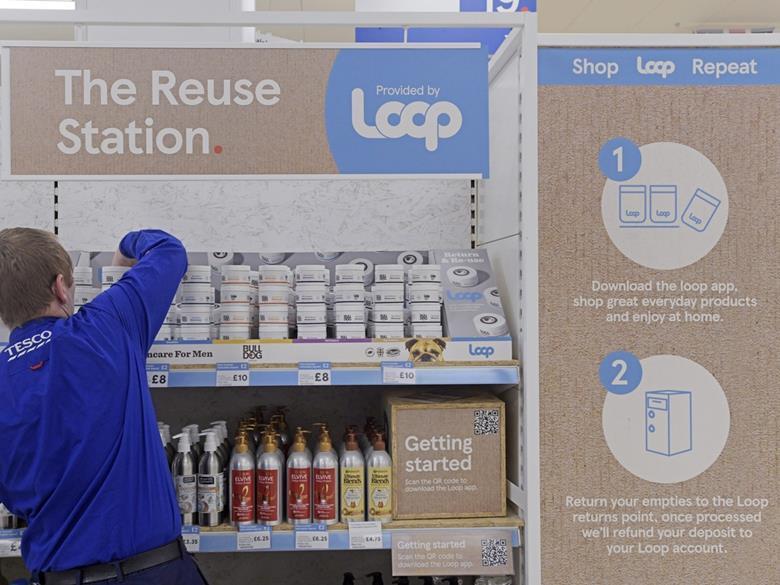
- Make small changes: Many of the more successful startups in the reuse / refill sphere, according to Chris, have been those that ‘mirror’ aspects of the current linear supply chain. “With returnable reusable packaging (what some prefer to call ‘pre-filled’), for example, you can achieve great supply chain efficiencies getting products to the store in bulk as you don’t have to change a lot in the supply chain.” Projects in this space include, of course, Loop but also companies like Reposit in the UK.
- Ensure full business buy-in: Every member of the team needs to be on-board and willing to actively participate in a proposed move to reuse/refill as it will – initially at least – require not just financial investment but also training key members of the team on how to operate it, understand the evolving regulatory environment and how to scale. In some cases, this may involve bringing in outside expertise to get things off the ground.
- Gather your own data: According to Tracy, it is important for companies to “get their own data and develop their own business case. An increasing amount of data exists but you really do need to gather your own otherwise decisions will be based on the data from someone else’s customers, supply chain or packaging impacts.” Remember, as we said above, that every case is unique so another company’s data – however valid – will not necessarily chime with your own situation. Another thing to note: Life cycle assessments are notoriously variable in quality and accuracy, and some market research can be biased or misleading – particularly if it is aligned with certain corporate interests.
- Be transparent about failures: Reuse is still at a fairly early stage in its implementation and all companies are learning from the experiences of others’. There has been much publicity about the reuse pilots and trials from major FMCG brands, but all members of the value chain should get used to being transparent about the results of their reuse pilots or schemes – even if, or perhaps especially if, they are unsuccessful, so the industry can try to understand why this was. Or, as Tracy succinctly puts it: “Be OK about not getting it right first time. No-one has or does. Doing something is better than doing nothing.”
And on that note: for further detailed and practical advice on getting started, we would like to point readers in the direction of Root’s ‘Getting to the Root of Reuse and Refill’. It lets companies of all sizes know how to begin putting their own reuse roadmap in place today.
If you liked this story, you might also enjoy:
How are the top brands progressing on packaging sustainability?
The ultimate guide to global plastic sustainability regulation
Sponsored stories

How ATS-Tanner’s banding solutions align with the new PPWR
ATS-Tanner’s banding solutions aim to reduce packaging waste, provide a practical alternative to plastic and improve recyclability. In

How Rollon’s linear systems provide reliability for tertiary packaging
Rollon believes tertiary packaging machinery must perform without fail, showcased by its recent partnership with AMP Automation to develop palletizing

Discover what’s new at London Packaging Week
Packaging has never carried greater commercial responsibility. It influences how consumers perceive brands, how products perform in increasingly competitive markets

Paperworld Middle East partners with FSC to champion responsible sourcing across the region’s paper and stationery industry
Paperworld Middle East, the region’s leading trade show for paper and stationery products, taking place from 13–15 October

Made for Life: How Sappi reveals what trees make possible
What connects an experienced papermaker, the creators of cactus-based leather, the people conserving forests for future generations, and a

The advantages of all-electric adhesive dispensing in modern packaging
Packaging manufacturers are under constant pressure to increase output, reduce operating costs, improve sustainability, and maintain consistent product quality. One

YUTO won 12 international packaging design awards across three global competitions
Driven by the global sustainability trend, the EU PPWR mandates packaging reduction, recyclable design, and restrictions on single-use packaging.

How rPS Food aims to bring circularity to polystyrene packaging
In this edition of the Spotlight, Coexpan (part of Grupo Lantero) details how its rPS Food enables up to 100%
Read next

Your chance to decide the winner of our 2026 Readers’ Award
The nomination period for Packaging Europe’s 2026 Readers’ Award has ended, the finalists have been selected, and now it’

Nemera launches bi-dose nasal spray solution
Drug delivery device company Nemera has announced its DuoSpray bi-dose nasal spray platform, a ‘non-invasive, needle free’ administration

Coveris develops mono-material sleeve with 30% less material for Dr Beckmann
Coveris has unveiled its mono-material sleeve solution developed for Dr Beckmann, said to use around 30% less material than