
PPWR Compliance Starts on the Factory Floor: Why Packaging Data is the Missing Piece
About the webinar PPWR is not just introducing new packaging requirements. It is raising the importance of accurate, traceable and

Introduction
In light of the heatwave that hit Europe in June 2026, this report examines the impact of climate change on the functionality of plastic packaging, as well as the environmental impacts of plastic waste in the wake of climate-related disasters.
Key takeaways
Conclusion
The balance between emergency measures and environmental responsibility remains thin, and disaster zones are one of the more extreme scenarios. Even so, the report reveals that climate change and plastic waste go hand-in-hand; and while plastics cannot, and sometimes should not, be replaced in every context, it is important to consider their vulnerabilities in hot conditions until society can bring global warming under control.
The recent heatwave in Europe has broken all previous temperature records, caused widespread disruption, and led to the deaths of 1300 people across the continent. A lesser-known fact, however, is that higher temperatures brought about by climate change also affect the disposal and functionality of plastic packaging.
In this edition of the Brief, we examine the impacts of this in everyday life and the aftermath of natural disasters, and consider all the complexities of addressing the problem.
According to a study led by Xin-Feng Wei and Mikael S. Hedenqvist from the KTH Royal Institute of Technology’s Fibre and Polymer Technology department and Wei Yang from the College of Polymer Science and Engineering at Sichuan University, climate change has noticeable implications for the functionality of plastic packaging.
Rising temperatures are thought to cause thermal expansion and impact the performance of conventional polymers. Research has indicated that exposure to 40°C heat can cause common plastics such as polyethylene, polypropylene, and polyvinyl chloride to lose 20% of their stiffness, and polymer ethylene vinyl alcohol can undergo a 75% decline in oxygen barrier efficiency.
Exposure to light, moisture, chemicals and mechanical stress can further accelerate the ageing process. When every 10°C increase is thought to double the degradation rate, warmer conditions can lead to oxidation, biodegradation, hydrolysis, UV degradation, and additive migration.
Creep, or slower deformation under mechanical stress, and subsequent relaxation may also happen more quickly, with potential implications for the shape of a plastic pack and the integrity of its seal.
Here is where the ‘vicious circle’ is thought to begin. Degraded plastic may lose its valuable properties and become less useful to recyclers, which condemns the unsuitable waste to decompose in landfills or else be incinerated. At the same time, manufacturers must compensate for the shortened lifespan of their plastics by manufacturing more. Of course, all these outcomes emit more greenhouse gases.
Nor is it only fossil-based plastics at risk. Exposure to wet conditions can cause biopolymers, polyamides and polyesters to soften, weaken and ultimately degrade – and for every 1°C rise in Earth’s temperature, our atmosphere can reportedly hold 7% more moisture, increasing the chances of rain and snow.
The outcome may not seem so dire when one considers how often misleading marketing, unclear labels, and consumer misconceptions divert industrially compostable materials away from the correct facilities, as another study makes clear. Could more rainfall help bioplastics break down faster?
Unfortunately, the implications are more serious. Higher levels of atmospheric moisture increase the risk of extreme precipitation events, which can trigger floods – and, incidentally, carry discarded plastic waste further afield.
Microplastics
Predictably, exposure to warmer climates causes waste plastics to leach additives – flame retardants, colourants, antioxidants, et cetera – at a faster rate due to accelerated diffusion and evaporation. Accelerated degradation also lends itself to the generation of secondary microplastics: tiny fragments resulting from the breakdown of larger plastics.
It is worth noting that research into the impacts of microplastics is still in its early stages and certain conclusions have come into question. Researchers have even suggested that the rising heat could fast-track the fragmentation of microplastics until they eventually disintegrate, but we should not assume that this is a rapid process; plastics can take hundreds of years to fully decompose.
In any case, the environmental impacts of microplastics are widely discussed. Sources indicate that they may release more greenhouse gases than larger units of waste, which feeds back into the ‘vicious circle’.
Intensified ageing processes have been linked to altered physicochemical properties and environmental behaviours in the microplastics themselves. One outcome is increased surface roughness and reduce hydrophobicity – a crucial detail, given that used plastic packaging is known to accumulate in rivers and on shorelines.
Even the tiniest plastic fragment in an aquatic environment can attract biofilms, or communities of microbial organisms, and set bacterial colonization into motion. This is a driving force behind the emerging ‘plastisphere’ in our waterways, with many of the microbes in these ecosystems contributing to climate change.
The presence of microplastics can also disrupt natural processes; this includes compromising the cellular structures and food absorption of plankton species and interrupting carbon sequestration. At the same time, warming waters will speed up the degradation of marine plastics, increasing the influx of new particles.
Nor are microbes the only concern. Marine turtle populations are becoming overwhelmingly female as warming climates skew the temperature-dependent sex determination of their embryos, which has obvious implications for their birth rates. Microplastics in coastal sand are playing a role, as they increase the temperatures of incubating clutches.
Meanwhile on land, early research indicates that microplastics could impact the health of certain crops. Some investigations have found that the combined effects of heat and plastic particles impacts the quantity and quality of rice growth, while others report no evidence that microplastics worsen the effects of drought on grassland or soil.
Regardless of their location, the impacts aren’t isolated, and they often become cyclical. For example, rivers can carry microplastics into the ocean, where sea spray can deposit them back onto the beach.
Several studies have compared the movement of microplastics through the atmosphere to natural biogeochemical cycles, reportedly travelling over tens of kilometres to otherwise unpolluted areas. So, too, are existing cycles affected by microplastics in the atmosphere; this affects the Earth’s cooling processes and contributing to cloud formation and dust transport.
Natural disasters
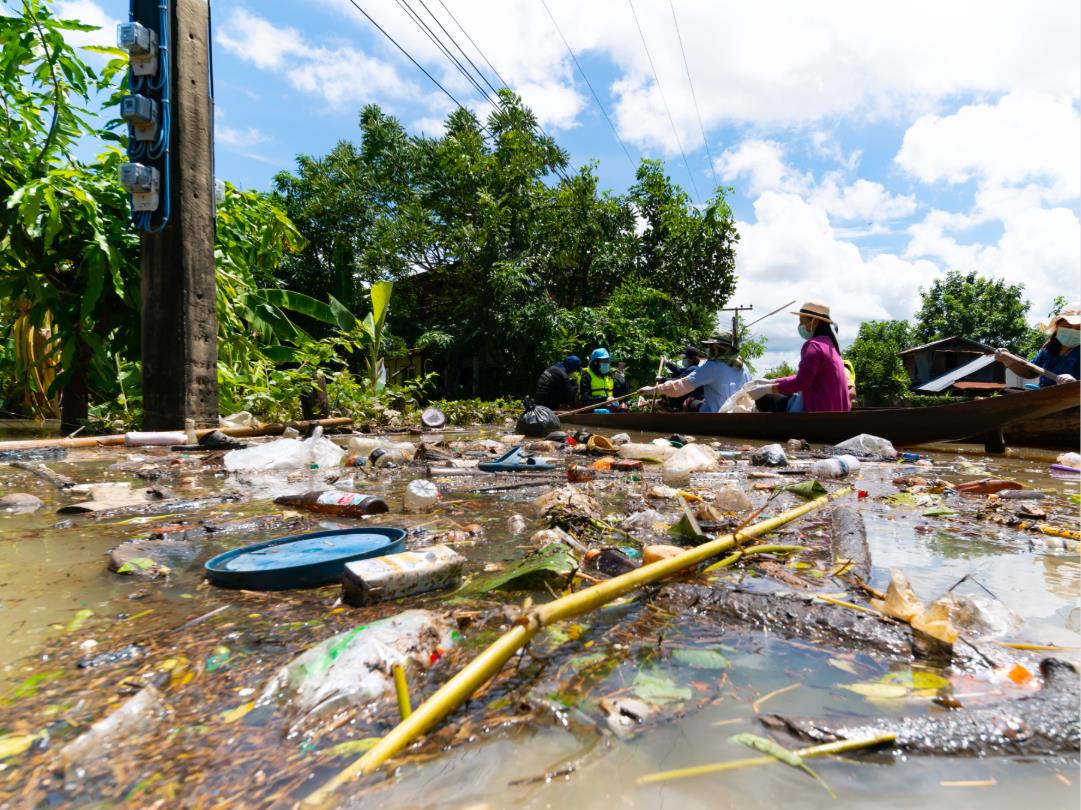
With climate change comes an increase in natural disasters, and one concern is that these extreme conditions will continue to disperse plastic waste. Strong winds, heavier rain, and rising sea levels are all capable of carrying discarded packaging from one place to another – and if plastics trapped in coastal sediments become dislodged, the risk of flooding can increase.
The United Nations Office for Disaster Risk Reduction also warns that plastic pollution and climate change can compromise natural protections against hazardous conditions, such as mountain ecosystems and coastal vegetation.
As the consequences intensify, the rising demand for humanitarian aid supplies has a knock-on effect on packaging production and its end-of-life disposal.
In the immediate aftermath of a disaster, it is unlikely that recycling or reuse systems will be the main priority, if they are even possible under the circumstances. The Disaster Waste Management Guidelines from the United Nations Office for the Coordination of Humanitarian Affairs state that leftover packaging materials, especially those used in healthcare contexts, should be landfilled in the short term.
Incineration is sometimes considered the safest option, both to stop the spread of disease and to prevent stagnant waste from impacting the surrounding environment. Uncontrolled burning can worsen air quality, so special disaster zone incinerators are sometimes used – and treating waste locally is also expected to avoid transport-related emissions.
If waste can be safely stored until the dust settles, relief organizations could partner with local recyclers and support economic recovery in the aftermath. However, sufficient recycling infrastructure may not exist in some locations.
Local sustainability legislation can complicate the situation further, with single-use plastic bans known to stall the shipment of relief packages until the offending materials have been removed. Solutions are coming to light, but navigating the trade-offs can be difficult – as illustrated in a report by the USAID Bureau for Humanitarian Assistance’s Joint Initiative for Sustainable Humanitarian Assistance Packaging Waste Management.
The International Committee of the Red Cross has conducted a pilot to transport non-food items to detainees in Afghanistan via recycled, unbleached cardboard boxes. While the pilot was believed to cut down on plastic waste, the shift to cardboard was found to be more carbon-intensive due to the material’s weight, feeding into the ‘vicious circle’ once again.
Cardboard boxes are also larger and more rigid than some plastic formats. The less efficient use of freight space translates to more deliveries and further greenhouse gas emissions.
Alongside its work with Mondi to explore virgin and recycled paper-based alternatives for food aid packages, the UN World Food Programme has experimented with removing all packaging from food supplies at Cox’s Bazar refugee camps in Bangladesh – a location that has previously fallen victim to monsoon flooding and fire outbreaks.
This is not a universal solution, though. Products such as flour and anchovies still require disposable packaging to maintain their quality and/or safety.
Durability is another key consideration, since unnecessary food loss – and material waste, in the case of poorly packaged supplies – leads to decomposition and yet more emissions. Swapping materials can also sacrifice some of the useful functionality of plastics in disaster zones: e.g. the inflation capabilities of polythene packaging, which can be overfilled with air and floated through flooded areas.
Where the protective qualities of plastic films are essential, efforts to limit their carbon impact continue. The United Nations High Commissioner for Refugees has started transporting thermal blankets in polypropylene bales, implementing recycled content wherever possible.
The move is said to have reduced packaging weight by 20% and lowered CO2 emissions by 17%, all without affecting its thermal resistance. This is anticipated to make a positive difference when 60% of the organization’s greenhouse gas emissions are attributed to core relief items.
It has also demonstrated the value of tailoring packaging solutions to suit different end uses while tackling specific issues. For instance, its bleached white cardboard boxes with blue logos have been replaced with recycled brown board and black, water-based ink to avoid the impacts of leaching.
The balance between emergency measures and environmental responsibility remains thin, and disaster zones are one of the more extreme scenarios. Nevertheless, it remains clear that our climate impacts the performance of plastics just as much as plastic production and disposal affect our climate. While these versatile materials are the right choice in some contexts, it is important to consider their vulnerabilities in hot conditions until we can bring global warming under control.
If you liked this story, you might also enjoy:
The ultimate guide to packaging innovation in 2026
Packaging and Packaging Waste Regulation: what to know in 2026
Everything you need to know about global packaging sustainability regulation

ATS-Tanner’s banding solutions aim to reduce packaging waste, provide a practical alternative to plastic and improve recyclability. In

Rollon believes tertiary packaging machinery must perform without fail, showcased by its recent partnership with AMP Automation to develop palletizing

Packaging has never carried greater commercial responsibility. It influences how consumers perceive brands, how products perform in increasingly competitive markets

Paperworld Middle East, the region’s leading trade show for paper and stationery products, taking place from 13–15 October

What connects an experienced papermaker, the creators of cactus-based leather, the people conserving forests for future generations, and a

Packaging manufacturers are under constant pressure to increase output, reduce operating costs, improve sustainability, and maintain consistent product quality. One

Driven by the global sustainability trend, the EU PPWR mandates packaging reduction, recyclable design, and restrictions on single-use packaging.

In this edition of the Spotlight, Coexpan (part of Grupo Lantero) details how its rPS Food enables up to 100%

Drug delivery device company Nemera has announced its DuoSpray bi-dose nasal spray platform, a ‘non-invasive, needle free’ administration

Coveris has unveiled its mono-material sleeve solution developed for Dr Beckmann, said to use around 30% less material than

Prevented Ocean Plastic is a finalist in this year’s Sustainability Awards with its project seeking to recycle polypropylene (PP)

If PPWR forces us to rethink packaging anyway, why stop at compliance? Peter Stael, owner and partner at Across-Consult,