

In a rush? Click here to read a short summary of this story
This report explores how online resale platforms like Vinted, Depop, and Etsy are handling the growing demand for sustainable packaging. With regulations lagging and responsibility largely falling on individual sellers, the report highlights the tension between product protection, carbon impact, and consumer-led reuse.
- Cardboard dominates but has a high carbon footprint: Vinted sellers primarily use cardboard boxes, which protect items well but contribute significantly to packaging emissions – more than lighter alternatives like kraft mailers.
- Reuse delivers major carbon savings: Reusing packaging reduced emissions by 70% in Vinted’s 2021 estimates, and 62% of users already reuse materials, often driven by personal ethics or platform encouragement.
- Guidance is optional and limited: Platforms like Vinted and Depop offer packaging tips but no formal requirements or enforcement, due to their status as intermediaries under current EU rules.
- Buyers respond positively to visible sustainability: Features like Depop’s “reused packaging” stickers and Etsy’s eco-packaging partnerships boost buyer trust and can increase sales.
- Small sellers face cost barriers: While sustainable packaging options exist, they’re often priced for frequent sellers, leaving casual users reliant on DIY solutions with mixed environmental outcomes.
- Policy clarity is needed: eBay is pushing for simplified packaging rules under Extended Producer Responsibility (EPR) to help sellers comply without overcomplicating the process.
Sustainable packaging on resale platforms is progressing, but unevenly. With little regulatory pressure, progress relies on consumer initiative, seller creativity, and platform nudges. To scale sustainability, marketplaces need clearer policies, affordable tools, and better education until legislation catches up.
On the heels of our previous investigation into fast-fashion packaging, we turn our attention to online marketplaces. What is the outlook on sustainable packaging in consumer-to-consumer sales, and can it ever be fully enforced? If so, who is responsible – the sellers or the platforms? We ask all these questions in this edition of the Brief.
Keeping up with the trends
Durability and product protection are important considerations for delivery packaging. Online marketplaces usually allow users to review sellers for all to see, so any experience with damage or inefficiency, whether it relates to the packaging or the item, could lead to negative feedback and impact future sales.
In the ‘packaging rules’ listed on its help centre, Vinted Go, the logistics arm of Vinted Group, advises sellers on ways to prevent dirt or moisture from causing damage in transit. Dissuading the use of “regular paper bags”, it instead recommends that sellers ship products in cardboard boxes; “ideally” one that corresponds to the item’s size and weight, but two or three layers are advised “if an item is heavier than usual”.
Unsurprisingly, then, a climate impact report conducted in collaboration with Vaayu named cardboard boxes the most popular packaging used by Vinted sellers in 2021 – but it also considered them the most carbon-intensive due to the amount of material used to manufacture them. Kraft paper mailers and envelopes were highlighted as a lower-emissions option, attributed in part to their reduction of air; yet only 30% of shipments were estimated to use a paper bag or envelope (whether new or reused).
Fillers also help keep the product intact, the ‘rules’ say. They list bubble wrap, foam, paper, newspaper, and corrugated material as equally viable options. While Vinted Go clarifies its preference for delivering electronic devices in their original boxes, bubble wrap or air cushions will apparently suffice – especially if they are reinforced by a double- or triple-walled outer box.
Seemingly, pack and product integrity are Vinted’s primary concerns. Perhaps this isn’t completely unwarranted; Vaayu calculates that, on average, packaging accounts for only 3.12% of Vinted’s carbon impact per transaction. Fellow online marketplace Depop goes so far as to exclude packaging from its recently published environmental impact measurement methodology, citing its “negligible” impact on an apparel item’s overall footprint in line with a study from Quantis.
However, the 286,465 tonnes of Scope 3 CO2e emissions recorded by Vinted in 2022 include “optional” sources like its members’ packaging. This figure far outweighed its Scope 1 and 2 emissions (recorded at 27 and 533 tonnes, respectively) – and yet, beyond recommendations, the company provides little guidance on responsible packaging practices.
Nor should emissions be the only environmental consideration. Paper and cardboard represent a global average of 17% of municipal solid waste, and while it is widely recycled – Europe reached a cardboard recycling rate of 83.2% in 2022, according to Eurostat – the remainder could end up in landfill, where a lack of moisture and air could preserve it for years. Even in the natural environment, the time it takes to biodegrade can fluctuate based on climate and weather conditions.
All this emphasizes the current roadblock virtual marketplaces face: how to regulate the packaging used by their sellers.
Swings and roundabouts
“Be sure to reuse your packaging,” Vinted says in its Impact Report 2023, and encourages sellers to fit their boxes or bags to the item. This is the document’s only mention of packaging, appearing under ‘tips for more mindful shopping’.
According to a climate impact report, 62% of Vinted users delivered products in reused packaging in 2021, saving over 17.15kt of CO2e. This was believed to reduce emissions by 70% compared to new packaging materials.
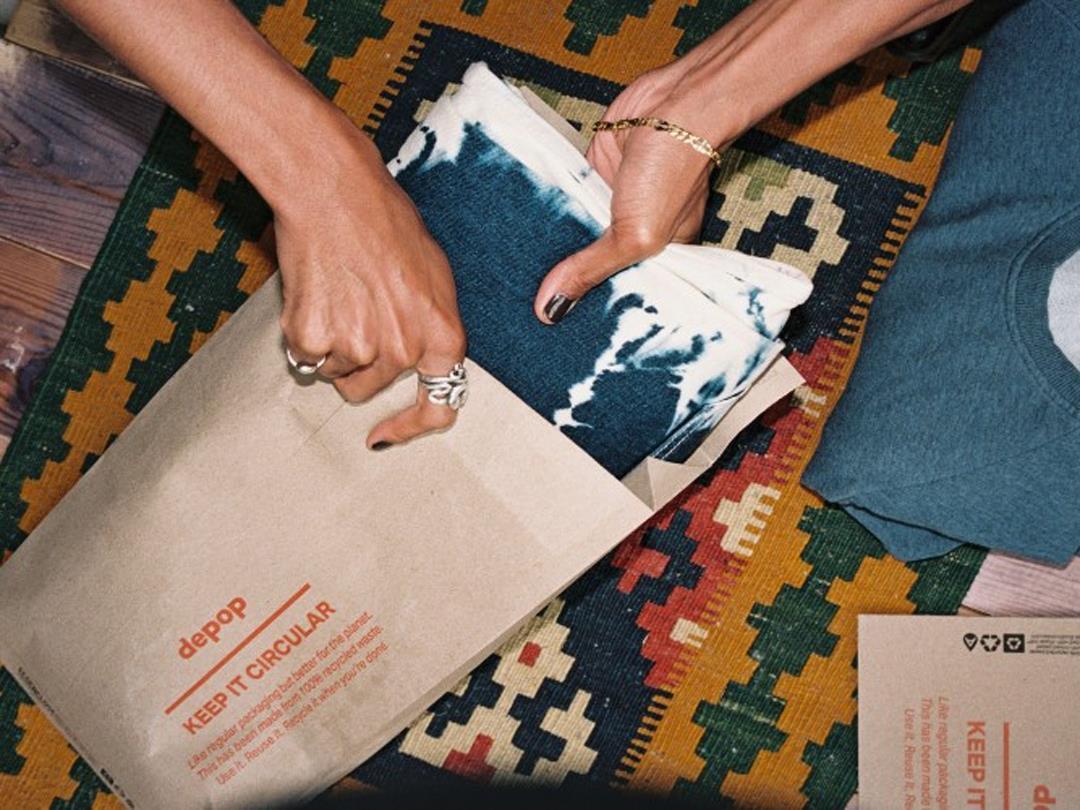
Depop’s method of encouraging reuse is to provide participating sellers with a reused packaging sticker. It is reportedly made with 100% post-consumer recycled content and printed on uncoated paper, while the sticker itself and its backer sheet can both be recycled at end-of-life.
“We know it can seem counterintuitive to add more packaging through a sticker, but we think it’s a great way to let buyers know that reuse matters to your business,” the company says.
Both approaches are optional, which could be influenced by a lack of regulation. Only platforms that sell their own products (or claim ownership over products sold through the platform), provide their own (branded) packaging, or operate with centralized logistics are held directly responsible for fulfilling the obligations of the Packaging and Packaging Waste Regulation, for example.
As they stand, most consumer-to-consumer marketplaces are considered intermediaries and are not subject to the Regulation. Whether or not independent sellers are considered “producers” and thus held to corresponding rules is a grey area; occasional sellers certainly aren’t, but those running an independent business are tricker to define.
eBay is attempting to iron out definitions by petitioning EU policymakers. Since they have no access to the products sold on their platforms, online marketplaces are not formally recognized as “producers”; but the petition suggests they be provided with a simplified regime to help small businesses declare their goods to EPR organizations. If passed, similar rules could eventually apply to product packaging.
Until that point, consumers themselves are advocating for reuse. For example, TikTok user ‘cascaydelowplasticliving’ demonstrates how household packaging like paper carrier bags or empty boxes for teabags or cereal can be repurposed for Vinted deliveries.
A downside to this approach is that the average consumer may not have the same detailed understanding of a ‘sustainable material’ as an industry professional. Without direction from the platform or elsewhere, a seller may unwittingly compromise the reusability or recyclability of their pack: for example, by applying excessive tape made of unrecyclable materials to an otherwise recyclable cardboard box.
Depop’s solution is to provide its users with sustainability-minded packaging. Besides its reuse sticker, its partnership with EcoEnclose encourages sellers in the United States to purchase “affordable” and home-recyclable packaging, reportedly made entirely from responsibly sourced and recycled paper.
Available in multiple sizes and quantities, the packaging is said to be water-resistant, with sellers able to opt in or out of on-pack Depop branding. Padded mailers, tissue paper, and die-cut honeycomb paper are also available to order.
Nor is it only ‘recommerce’ platforms making the transition. Etsy, an online marketplace for handmade or vintage items and craft supplies, has partnered with EcoEnclose to offer U.S. sellers packaging made from 100% recycled materials or certified responsibly sourced paper. In a subsequent survey, 57% of buyers reported being more inclined to purchase an item if it was shipped in recyclable packaging.
“Paper-based material has been one of the most commonly accepted recyclables in the U.S., with recycling rates of up to 96.5%,” the company explains in its Seller Handbook. “So when your buyer receives this Planet-Friendly Packaging made of 100% recycled materials or responsibly sourced paper, they can either reuse it or put it directly into a paper recycling bin.”
Users of both platforms can select different sizes and quantities of each product in line with their own needs or finances. Depop sellers can pay between $3 for one sheet of stickers and $107.16 for 250 12” x 15” mailers; Etsy’s prices range between $9 for a roll of industrially compostable cello tape and $107 for a 19” x 750’ roll of GreenWrap bubble wrap alternative with a built-in dispenser.
Beyond just EcoEnclose, plenty of Etsy users sell their own packaging solutions, from customizable cardboard boxes to poly mailers, cotton pouches, pulp clamshells, and shredded tissue filler.
Arguably, though, solutions like these are geared more towards independent businesses and other frequent sellers. As eBay explains in its ‘11 tips for a sustainable seller’, compostable packaging made from corn starch, hemp, palm leaves, and other materials “can be more expensive than regular corrugated cardboard, but […] can contribute to your company’s image and help you build trust with buyers.” The same could be said for biobased void fillers made of bamboo, seaweed, etc.
On the other hand, casual or one-off users looking to profit from second-hand goods may be unlikely to spend too much extra money on packaging, especially if the item itself is inexpensive. Moreover, 47% of respondents to a Statista survey use Vinted, in particular, because pre-used items are cheaper than new ones; buyers like these may be dissuaded from paying premium to cover packaging costs, or may even be unable to.
Making good choices
Perhaps the cheapest sustainability-minded solution is repurposing empty household bags or boxes into delivery packaging. With 20% of Vinted shoppers and 60% of Depop users choosing second-hand for environmental reasons, it is likely that a reused container would be received positively.
Of course, considerations should still be made for the durability of the product and the pack. Is the box or bag in good enough condition to reuse? Can it accommodate the shape or weight of the product? Is it the optimal size for its contents, or will it require void filler? If sellers do not already own a suitable pack, eBay says that some postal services let consumers collect unclaimed cardboard boxes from post offices or pickup points: “Give them a new lease on life by using them to ship your orders.”
The company goes on to recommend the use of shredded paper or cardboard as void filler, since it “provides great protection for your items, but at the same time it’s perfectly biodegradable and made from a renewable resource (wood fibre)”. It reports that frequent eBay sellers sometimes invest in a cardboard shredder to repurpose old boxes, and either print or label a pack to a) recommend reuse or b) instruct buyers on the appropriate recycling process for each material.
For now, the onus is still on sellers to pack their products responsibly, and on buyers to prolong the packaging’s lifespan, whether as a whole container or as recyclate. Ideally, regulations will evolve to give marketplaces themselves more control over its sellers, and more responsibility to push for environmental responsibility.
Until then, though, it is in our best interest to keep the general public up to speed on sustainable packaging practices. While it won’t guarantee everyone’s participation, plenty of consumers – especially the sustainability-minded users of second-hand marketplaces like Depop and Vinted – want to be part of the solution. Given the right information, they could drive a culture of consumer-to-consumer sustainability that does not rely on the bureaucratic process of passing legislation.
If you liked this story, you might also enjoy:
The ultimate guide to the Packaging and Packaging Waste Regulation in 2024
How are the top brands progressing on packaging sustainability?
Sustainable Innovation Report 2024: Current trends and future priorities
Everything you need to know about global plastic sustainability regulation
Sponsored stories

How ATS-Tanner’s banding solutions align with the new PPWR
ATS-Tanner’s banding solutions aim to reduce packaging waste, provide a practical alternative to plastic and improve recyclability. In

How Rollon’s linear systems provide reliability for tertiary packaging
Rollon believes tertiary packaging machinery must perform without fail, showcased by its recent partnership with AMP Automation to develop palletizing

Discover what’s new at London Packaging Week
Packaging has never carried greater commercial responsibility. It influences how consumers perceive brands, how products perform in increasingly competitive markets

Paperworld Middle East partners with FSC to champion responsible sourcing across the region’s paper and stationery industry
Paperworld Middle East, the region’s leading trade show for paper and stationery products, taking place from 13–15 October

Made for Life: How Sappi reveals what trees make possible
What connects an experienced papermaker, the creators of cactus-based leather, the people conserving forests for future generations, and a

The advantages of all-electric adhesive dispensing in modern packaging
Packaging manufacturers are under constant pressure to increase output, reduce operating costs, improve sustainability, and maintain consistent product quality. One

YUTO won 12 international packaging design awards across three global competitions
Driven by the global sustainability trend, the EU PPWR mandates packaging reduction, recyclable design, and restrictions on single-use packaging.

How rPS Food aims to bring circularity to polystyrene packaging
In this edition of the Spotlight, Coexpan (part of Grupo Lantero) details how its rPS Food enables up to 100%
Read next


Südpack unveils mono-PP pouch solution for yoghurt drink market
Südpack has launched a recyclable, mono-material polypropylene (PP) flexible pouch aimed at the drinkable yoghurt market. The company identifies

Nemera launches bi-dose nasal spray solution
Drug delivery device company Nemera has announced its DuoSpray bi-dose nasal spray platform, a ‘non-invasive, needle free’ administration

Coveris develops mono-material sleeve with 30% less material for Dr Beckmann
Coveris has unveiled its mono-material sleeve solution developed for Dr Beckmann, said to use around 30% less material than