
Silgan presents new pump for refillable moulded glass formats
Silgan Dispensing has introduced its Melodie Pirouette SNI 13 pump, a solution that is designed to enable perfume houses to

In this edition of the Spotlight, PerkinElmer outlines the potential shortcomings in current packaging designs and explains how regulation and research combine to create outcomes that are safe for both living things and the planet.
The purpose of packaging analysis is two-fold:
1. To prevent external contamination from entering the product to be ingested.
2. To avoid having the packaging become a source of contamination to people, animals, and the environment.
Packaging has become well-regulated and governmentally legislated with basic requirements that help protect consumers by ensuring the integrity and safety of ingested items. As indicated in the table, when packaging fails, serious and far-reaching problems can follow suit.
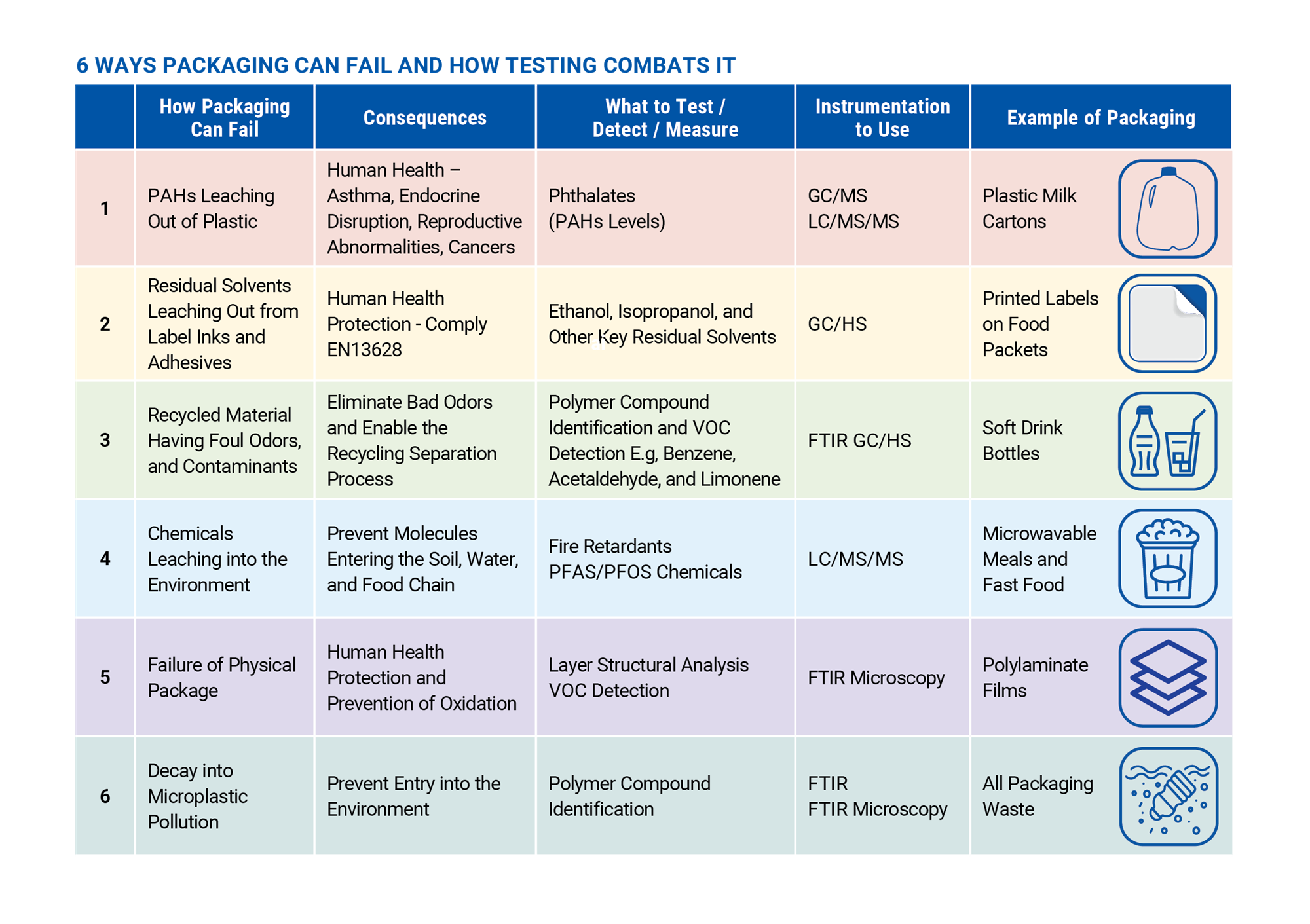
Most food packaging is multi-layered and made of laminates. Barrier layers within packaging can ensure food safety, add shelf-life, and can create an oxygen, aroma, and flavor barrier. Layered food packaging protects food, improves manufacturing operations, reduces damage and waste, enables better retail and food service storage, and more.
However, plastic packaging adds just as many layers of concern. In recent decades, it has been discovered that chemical compounds and microplastics can leach out of the packaging. As a result, scientists and government departments are collaborating to prevent leaching and other dangerous issues from occurring through the analysis of chemical structure, temperature, storage time, humidity, physical characteristics, and other factors.
Food regulation continues to improve and evolve. Researchers and regulators are actively working together to identify leachable compounds and determine acceptable levels for the safety of human health, animal health, and the environment. New threats are likely to emerge. For example, PFAS started as an environmental issue and have rapidly evolved into a food safety issue.
Learning how to better test, detect, and measure plastic packaging will surely continue to evolve, creating real-world solutions to this ongoing concern.
You can learn more about PerkinElmer laboratory solutions for polymers and packaging at https://www.perkinelmer.com/.
This content was sponsored by PerkinElmer.

ATS-Tanner’s banding solutions aim to reduce packaging waste, provide a practical alternative to plastic and improve recyclability. In

Rollon believes tertiary packaging machinery must perform without fail, showcased by its recent partnership with AMP Automation to develop palletizing

Packaging has never carried greater commercial responsibility. It influences how consumers perceive brands, how products perform in increasingly competitive markets

Paperworld Middle East, the region’s leading trade show for paper and stationery products, taking place from 13–15 October

What connects an experienced papermaker, the creators of cactus-based leather, the people conserving forests for future generations, and a

Packaging manufacturers are under constant pressure to increase output, reduce operating costs, improve sustainability, and maintain consistent product quality. One

Driven by the global sustainability trend, the EU PPWR mandates packaging reduction, recyclable design, and restrictions on single-use packaging.

In this edition of the Spotlight, Coexpan (part of Grupo Lantero) details how its rPS Food enables up to 100%

BEUMER Group has launched a fully autonomous robotic picking and singulation solution – reportedly able to handle 99.9% of bulk

What does your business need to do next to comply with the Packaging and Packaging Waste Regulation (PPWR)? With just

Amazon is developing ‘extensible’ paper packaging with a water-soluble coating, said to double or triple the flexibility of standard

Recent trials by NEXTLOOPP, Süper Film and Brückner Maschinenbau have reportedly demonstrated for the first time that food-grade recycled